
Turn on suggestions
Auto-suggest helps you quickly narrow down your search results by suggesting possible matches as you type.
Splunk Search
×
Join the Conversation
Without signing in, you're just watching from the sidelines. Sign in or Register to connect, share, and be part of the Splunk Community.
- Find Answers
- :
- Using Splunk
- :
- Splunk Search
- :
- Re: Extract Fields from JSON
Options
- Subscribe to RSS Feed
- Mark Topic as New
- Mark Topic as Read
- Float this Topic for Current User
- Bookmark Topic
- Subscribe to Topic
- Mute Topic
- Printer Friendly Page
- Mark as New
- Bookmark Message
- Subscribe to Message
- Mute Message
- Subscribe to RSS Feed
- Permalink
- Report Inappropriate Content

felipesodre
Path Finder
07-09-2020
01:36 PM
Hi Everyone. Thanks in advance for any help.
I am trying to extract some fields (Status, RecordsPurged) from a JSON on the following _raw text:
{"": "INFO : 2020-07-09T01:11:08Z : [[email protected]]: {\"Purging_Results_Test\": {\"NewPurging\": 1, \"Status\":\"Successful\", \"VacuumEnabled\": true, \"RecordsPurged\": 6646, \"StartTime\":\"8-Jul-2020 18:03:07\", \"EndTime\":\"8-Jul-2020 18:11:08\", \"Duration(min)\":8.02}}"}
Any Ideas that might help me out?
Thank you so much.
1 Solution
- Mark as New
- Bookmark Message
- Subscribe to Message
- Mute Message
- Subscribe to RSS Feed
- Permalink
- Report Inappropriate Content

richgalloway

SplunkTrust
07-10-2020
09:55 AM
You mean like this?
| makeresults
| eval _raw="{\"\": \"INFO : 2020-07-09T01:11:08Z : [[email protected]]: {\"Purging_Results_Test\": {\"NewPurging\": 1, \"Status\":\"Successful\", \"VacuumEnabled\": true, \"RecordsPurged\": 6646, \"StartTime\":\"8-Jul-2020 18:03:07\", \"EndTime\":\"8-Jul-2020 18:11:08\", \"Duration(min)\":8.02}}\"}"
| rex "Purging_Results_Test\": (?<PurgingResultsTest>.*?})"
| spath input=PurgingResultsTest
---
If this reply helps you, Karma would be appreciated.
If this reply helps you, Karma would be appreciated.
- Mark as New
- Bookmark Message
- Subscribe to Message
- Mute Message
- Subscribe to RSS Feed
- Permalink
- Report Inappropriate Content
richgalloway
SplunkTrust
07-09-2020
02:32 PM
Normally, one uses spath to parse JSON, but it doesn't like your sample text. So rex will do, instead.
... | rex "Status\":\"(?<Status>\w+)" | rex "RecordsPurged\": (?<RecordsPurged>\d+)"
---
If this reply helps you, Karma would be appreciated.
If this reply helps you, Karma would be appreciated.
- Mark as New
- Bookmark Message
- Subscribe to Message
- Mute Message
- Subscribe to RSS Feed
- Permalink
- Report Inappropriate Content
felipesodre
Path Finder
07-10-2020
08:21 AM
Hi, sorry for the late reply and thanks for your help.
For some reason your code works for some fields and others don't. Please see the image attached.
Any ideas that might help?
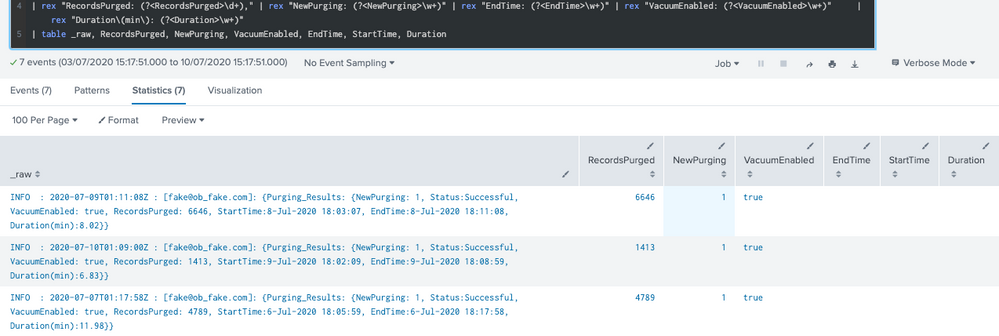
Is it possible to get the JSON of Purging_Results: {all content in here} using regex and then navigate to the fields using a spath?
- Mark as New
- Bookmark Message
- Subscribe to Message
- Mute Message
- Subscribe to RSS Feed
- Permalink
- Report Inappropriate Content
richgalloway
SplunkTrust
07-10-2020
09:55 AM
You mean like this?
| makeresults
| eval _raw="{\"\": \"INFO : 2020-07-09T01:11:08Z : [[email protected]]: {\"Purging_Results_Test\": {\"NewPurging\": 1, \"Status\":\"Successful\", \"VacuumEnabled\": true, \"RecordsPurged\": 6646, \"StartTime\":\"8-Jul-2020 18:03:07\", \"EndTime\":\"8-Jul-2020 18:11:08\", \"Duration(min)\":8.02}}\"}"
| rex "Purging_Results_Test\": (?<PurgingResultsTest>.*?})"
| spath input=PurgingResultsTest
---
If this reply helps you, Karma would be appreciated.
If this reply helps you, Karma would be appreciated.
- Mark as New
- Bookmark Message
- Subscribe to Message
- Mute Message
- Subscribe to RSS Feed
- Permalink
- Report Inappropriate Content
felipesodre
Path Finder
07-10-2020
10:13 AM
It just worked perfectly.
Thank you so much, appreciate it!!!!


Got questions? Get answers!
Join the Splunk Community Slack to learn, troubleshoot, and make connections with fellow Splunk practitioners in real time!
Meet up IRL or virtually!
Join Splunk User Groups to connect and learn in-person by region or remotely by topic or industry.
Get Updates on the Splunk Community!
Thanks for the Memories: .conf26 Took Learning to New Heights
Thank you, Splunk Community, for making .conf26 in Denver one for the books. From packed Splunk University ...
Best Practices: Splunk auto adjust pipeline queue
When you enable autoAdjustQueue in Splunk, maxSize should be understood as the queue size Splunk starts with ...
Splunk Auto Ingestion Parallel Pipeline Scaling
Why this feature matters
Many Splunk environments experience ingestion pressure long before the host is fully ...
