
Join the Conversation
- Find Answers
- :
- Apps & Add-ons
- :
- All Apps and Add-ons
- :
- All Apps and Add-ons
- :
- How to write Data Model mapping expressions in add...
- Subscribe to RSS Feed
- Mark Topic as New
- Mark Topic as Read
- Float this Topic for Current User
- Bookmark Topic
- Subscribe to Topic
- Mute Topic
- Printer Friendly Page
- Mark as New
- Bookmark Message
- Subscribe to Message
- Mute Message
- Subscribe to RSS Feed
- Permalink
- Report Inappropriate Content

I am building an add-on with the Splunk Add-On builder and want to map some of my data to CIM types.
The "FIELDALIAS" mapping type is very straightforward and works fine. But I can't find any examples or documentation for how to do an "EVAL" type of mapping for the more complicated cases. Anyone know the proper way to format these expressions?
Thank you for any help!
- Mark as New
- Bookmark Message
- Subscribe to Message
- Mute Message
- Subscribe to RSS Feed
- Permalink
- Report Inappropriate Content

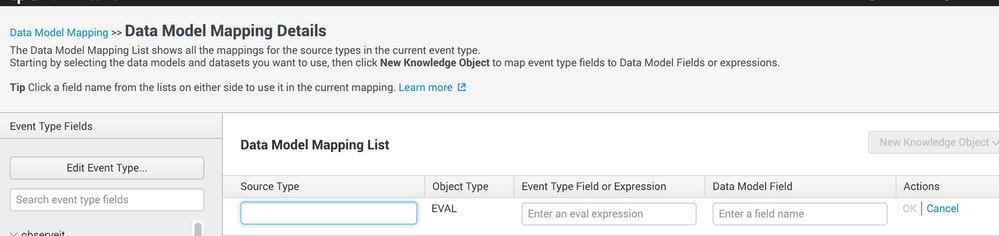
Basically this is an interactive tool to let you call Splunk Eval functions. Please refer Splunk documents for details.
https://docs.splunk.com/Documentation/SplunkCloud/7.1.3/SearchReference/CommonEvalFunctions
- Mark as New
- Bookmark Message
- Subscribe to Message
- Mute Message
- Subscribe to RSS Feed
- Permalink
- Report Inappropriate Content
Basically this is an interactive tool to let you call Splunk Eval functions. Please refer Splunk documents for details.
https://docs.splunk.com/Documentation/SplunkCloud/7.1.3/SearchReference/CommonEvalFunctions
- Mark as New
- Bookmark Message
- Subscribe to Message
- Mute Message
- Subscribe to RSS Feed
- Permalink
- Report Inappropriate Content
OK, thank you.
I have 2 scenarios
I want to populate a static string. Is the best way to do this with an expression like this: printf("%s","Foo")
I want to break up one field (a URL) into several fields in the Web CIM (uri_path and uri_query). I wrote a regular expression for this purpose, is there any way to use it here?



Join the Splunk Community Slack to learn, troubleshoot, and make connections with fellow Splunk practitioners in real time!
Join Splunk User Groups to connect and learn in-person by region or remotely by topic or industry.
SOC4Kafka - New Kafka Connector Powered by OpenTelemetry
Event Series: Level up your SOC: Advancing with Splunk Enterprise Security
Announcing Modern Navigation: A New Era of Splunk User Experience
