
Join the Conversation
- Find Answers
- :
- Using Splunk
- :
- Splunk Search
- :
- Remove field values from one multi-valued field wh...
- Subscribe to RSS Feed
- Mark Topic as New
- Mark Topic as Read
- Float this Topic for Current User
- Bookmark Topic
- Subscribe to Topic
- Mute Topic
- Printer Friendly Page
- Mark as New
- Bookmark Message
- Subscribe to Message
- Mute Message
- Subscribe to RSS Feed
- Permalink
- Report Inappropriate Content


Remove field values from one multi-valued field which values are present in another multi-valued field
Looking for something like:
| eval dest=mvfilter(if(dest IN email_sender, null(), dest))
Here dest contains both sender and receiver of the email. hence I'm trying to exclude the sender from it.
(FYI, the sender is also a multi-valued field that's because I've used stats before it.)
- Mark as New
- Bookmark Message
- Subscribe to Message
- Mute Message
- Subscribe to RSS Feed
- Permalink
- Report Inappropriate Content

Use mvmap. See this example
| makeresults count=1
| eval dest=split("User1,User2,User3,User4,User5",",")
| eval sender=split("User3,User7", ",")
| table sender dest
| eval dest=mvmap(dest,if(isnull(mvfind(sender,dest)),dest,null))
last line removes 'User3' from the dest field as it's one of the senders.
- Mark as New
- Bookmark Message
- Subscribe to Message
- Mute Message
- Subscribe to RSS Feed
- Permalink
- Report Inappropriate Content

If I'm not mistaken, mvfilter() does just that. You can use mvmap() to iterate over email_sender.
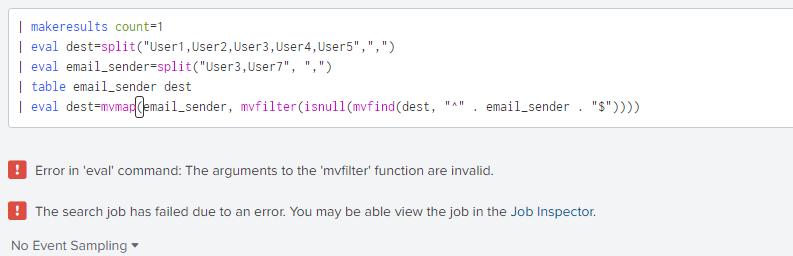
| eval dest=mvmap(email_sender, mvfilter(isnull(mvfind(dest, "^" . email_sender . "$"))))The mvfind() expression assumes that each email_sender would match the exact spelling if it appears in dest.
- Mark as New
- Bookmark Message
- Subscribe to Message
- Mute Message
- Subscribe to RSS Feed
- Permalink
- Report Inappropriate Content
Thanks @yuanliu. Logically I thought this should work but somehow mvfilter doesn't want to work. Anyways it worked with @bowesmana answer without mvfilter.
- Mark as New
- Bookmark Message
- Subscribe to Message
- Mute Message
- Subscribe to RSS Feed
- Permalink
- Report Inappropriate Content
I think I know why mvfilter gives error. mvfilter requires its argument to only involve one multivalue variable. But because of mvfind, it now involves both dest and email_sender, even though email_sender is actually single-valued inside the mvmap iterator. In fact, mvfilter will parse to error even if email_sender is genuinely single valued.
There might be some roundabout way to turn email_sender into a pattern substitution instead of a variable, but that is in itself too convoluted.
- Mark as New
- Bookmark Message
- Subscribe to Message
- Mute Message
- Subscribe to RSS Feed
- Permalink
- Report Inappropriate Content
@yuanliu - Yeah, mvfilter can reference only one field, the rest should be only string/pattens.
The expression can reference only one field.(From doc - https://docs.splunk.com/Documentation/SCS/current/SearchReference/MultivalueEvalFunctions)
- Mark as New
- Bookmark Message
- Subscribe to Message
- Mute Message
- Subscribe to RSS Feed
- Permalink
- Report Inappropriate Content
Use mvmap. See this example
| makeresults count=1
| eval dest=split("User1,User2,User3,User4,User5",",")
| eval sender=split("User3,User7", ",")
| table sender dest
| eval dest=mvmap(dest,if(isnull(mvfind(sender,dest)),dest,null))
last line removes 'User3' from the dest field as it's one of the senders.


Join the Splunk Community Slack to learn, troubleshoot, and make connections with fellow Splunk practitioners in real time!
Join Splunk User Groups to connect and learn in-person by region or remotely by topic or industry.
A Four-Part Event Series: Full Stack Observability For the AI Era
SOC4Kafka - New Kafka Connector Powered by OpenTelemetry
Event Series: Level up your SOC: Advancing with Splunk Enterprise Security
