
Join the Conversation
- Find Answers
- :
- Using Splunk
- :
- Splunk Search
- :
- Re: How to create table using nested json?
- Subscribe to RSS Feed
- Mark Topic as New
- Mark Topic as Read
- Float this Topic for Current User
- Bookmark Topic
- Subscribe to Topic
- Mute Topic
- Printer Friendly Page
- Mark as New
- Bookmark Message
- Subscribe to Message
- Mute Message
- Subscribe to RSS Feed
- Permalink
- Report Inappropriate Content
How to create table using nested json?

Hi All I have a nested JSON in my log event. On that basis, I have to create a dynamic table.
{status: FINISHED
data: [
{
duration: 123
status: A
}
{
duration: 456
status: B
}
{
duration: 678
status:C
}
]}
I need to create the table for this nested one
Table Structure :
| status | A | B | C |
| Finished | 123 | 456 | 678 |
Also, I have one more req. If in the future we get more values in the sub-part of JSON then can we add a column for that also
- Mark as New
- Bookmark Message
- Subscribe to Message
- Mute Message
- Subscribe to RSS Feed
- Permalink
- Report Inappropriate Content

- Mark as New
- Bookmark Message
- Subscribe to Message
- Mute Message
- Subscribe to RSS Feed
- Permalink
- Report Inappropriate Content
Hi, I have updated the duration name since it appears twice.
index=**** some search query |
| rename status as STATUS | spath path=data{} | mvexpand data{} | spath input=duration{} | chart values(duration) over STATUS by status
After running this query I am getting no result

- Mark as New
- Bookmark Message
- Subscribe to Message
- Mute Message
- Subscribe to RSS Feed
- Permalink
- Report Inappropriate Content
index=**** some search query |
| rename status as STATUS | spath path=data{} | mvexpand data{} | spath input=duration{} | chart values(duration) over STATUS by status
Sorry I didn't observe your sample data correctly. You are correct that the path to the array is data{}, not duration{}. As succh, in the next spath, input should also be data{}, not duration{}.
| rename status AS STATUS
| spath path=data{}
| mvexpand data{}
| spath input=data{}
| chart values(duration) over STATUS by status
(As a side: If you are posting sample JSON, make sure the format is conformant. I made the mistake when trying to correct the format.)
- Mark as New
- Bookmark Message
- Subscribe to Message
- Mute Message
- Subscribe to RSS Feed
- Permalink
- Report Inappropriate Content

I think a kvstore with json should do be what you want.. you can use collections.conf or the lookup file editor to define the non-json elements and type, and one for the array - then I would call them out explicitly in the transforms.conf file so you can play nicely with them using lookup and inputlookup>>>
The structure you settle on will depend on how you analyze this going forward, but I'd be tempted to start with this (you can view it in https://jsongrid.com/json-grid)
{
"status": "finished",
"duration_array": [
{
"status": "A",
"duration": 123
},
{
"status": "B",
"duration": 456
},
{
"status": "C",
"duration": 678
}
]
}
To use kvstore, you can define using the collections.conf, and lookup editor or the lookup file editor iin cloud
I prefer using the structure I have suggested as you can easily insert new status values,
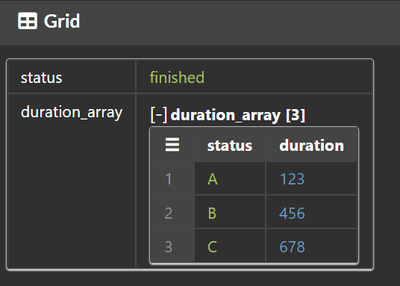
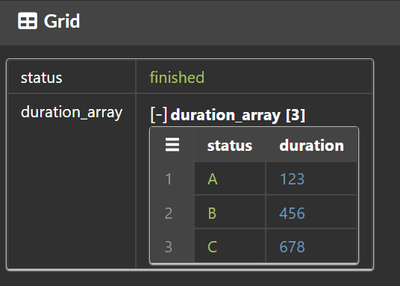
becomes
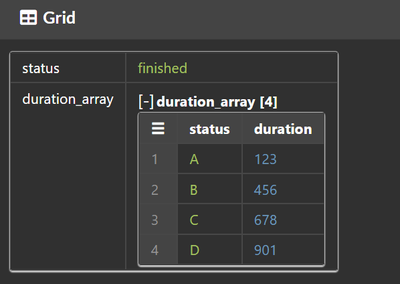
You should be able to refer to the data elements and do whatever you want - unless i'm missing the point
- Mark as New
- Bookmark Message
- Subscribe to Message
- Mute Message
- Subscribe to RSS Feed
- Permalink
- Report Inappropriate Content
I want splunk query for this

Join the Splunk Community Slack to learn, troubleshoot, and make connections with fellow Splunk practitioners in real time!
Join Splunk User Groups to connect and learn in-person by region or remotely by topic or industry.
Make Your Machine Data AI-Ready in Splunk
Splunk Asynchronous Forwarding Explained
How to Monitor AI Agents with Splunk Agent Observability
