
Turn on suggestions
Auto-suggest helps you quickly narrow down your search results by suggesting possible matches as you type.
Getting Data In
×
Join the Conversation
Without signing in, you're just watching from the sidelines. Sign in or Register to connect, share, and be part of the Splunk Community.
- Find Answers
- :
- Splunk Administration
- :
- Getting Data In
- :
- Re: How to parse JSON with multiple array
Options
- Subscribe to RSS Feed
- Mark Topic as New
- Mark Topic as Read
- Float this Topic for Current User
- Bookmark Topic
- Subscribe to Topic
- Mute Topic
- Printer Friendly Page
- Mark as New
- Bookmark Message
- Subscribe to Message
- Mute Message
- Subscribe to RSS Feed
- Permalink
- Report Inappropriate Content

cuongnguyen112
Engager
10-20-2019
09:07 PM
hi, i got data like this:
{
"source": "sadmin",
"sysinfo": {
"process_list": {
"56": {
"name": "nginx on",
"pid": 56,
"uid": 0,
"gid": 0
},
"57": {
"name": "nginx: worker process",
"pid": 57,
"uid": 33,
"gid": 33
},
}
}
}
i need to create a table from these data like below:
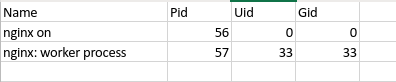
could any one please help me !!
1 Solution
- Mark as New
- Bookmark Message
- Subscribe to Message
- Mute Message
- Subscribe to RSS Feed
- Permalink
- Report Inappropriate Content

kamlesh_vaghela

SplunkTrust
10-20-2019
11:21 PM
@cuongnguyen112
Can you please try this?
YOUR_SEARCH | rename sysinfo.process_list.* as *
| eval field_name="",uid="",gid="",name="",pid=""
| foreach *.*
    [ eval field_name= mvindex(split("<<FIELD>>","."),1),val=case(field_name=="pid",pid,field_name=="gid",gid,field_name=="uid",uid,1=1,name), {field_name}=if(val!="",val.",","").'<<FIELD>>']
| eval tmp=mvzip(mvzip(mvzip(split(name,","),split(pid,",")),split(uid,",")),split(gid,","))
| fields _time tmp | mvexpand tmp | eval name=mvindex(split(tmp,","),0),pid=mvindex(split(tmp,","),1),uid=mvindex(split(tmp,","),2),gid=mvindex(split(tmp,","),3)
| table name pid uid gid
Sample Search:
| makeresults
| eval _raw="{\"source\": \"sadmin\",\"sysinfo\": {\"process_list\": {\"56\": {\"name\": \"nginx on\",\"pid\": \"56\",\"uid\": \"0\",\"gid\": \"0\"},\"57\": {\"name\": \"nginx: worker process\",\"pid\": \"57\",\"uid\": \"33\",\"gid\": \"33\"},}}}"
| spath
| rename sysinfo.process_list.* as *
| eval field_name="",uid="",gid="",name="",pid=""
| foreach *.*
    [ eval field_name= mvindex(split("<<FIELD>>","."),1),val=case(field_name=="pid",pid,field_name=="gid",gid,field_name=="uid",uid,1=1,name), {field_name}=if(val!="",val.",","").'<<FIELD>>']
| eval tmp=mvzip(mvzip(mvzip(split(name,","),split(pid,",")),split(uid,",")),split(gid,","))
| fields _time tmp | mvexpand tmp | eval name=mvindex(split(tmp,","),0),pid=mvindex(split(tmp,","),1),uid=mvindex(split(tmp,","),2),gid=mvindex(split(tmp,","),3)
| table name pid uid gid
Thanks
- Mark as New
- Bookmark Message
- Subscribe to Message
- Mute Message
- Subscribe to RSS Feed
- Permalink
- Report Inappropriate Content
kamlesh_vaghela
SplunkTrust
10-20-2019
11:21 PM
@cuongnguyen112
Can you please try this?
YOUR_SEARCH | rename sysinfo.process_list.* as *
| eval field_name="",uid="",gid="",name="",pid=""
| foreach *.*
    [ eval field_name= mvindex(split("<<FIELD>>","."),1),val=case(field_name=="pid",pid,field_name=="gid",gid,field_name=="uid",uid,1=1,name), {field_name}=if(val!="",val.",","").'<<FIELD>>']
| eval tmp=mvzip(mvzip(mvzip(split(name,","),split(pid,",")),split(uid,",")),split(gid,","))
| fields _time tmp | mvexpand tmp | eval name=mvindex(split(tmp,","),0),pid=mvindex(split(tmp,","),1),uid=mvindex(split(tmp,","),2),gid=mvindex(split(tmp,","),3)
| table name pid uid gid
Sample Search:
| makeresults
| eval _raw="{\"source\": \"sadmin\",\"sysinfo\": {\"process_list\": {\"56\": {\"name\": \"nginx on\",\"pid\": \"56\",\"uid\": \"0\",\"gid\": \"0\"},\"57\": {\"name\": \"nginx: worker process\",\"pid\": \"57\",\"uid\": \"33\",\"gid\": \"33\"},}}}"
| spath
| rename sysinfo.process_list.* as *
| eval field_name="",uid="",gid="",name="",pid=""
| foreach *.*
    [ eval field_name= mvindex(split("<<FIELD>>","."),1),val=case(field_name=="pid",pid,field_name=="gid",gid,field_name=="uid",uid,1=1,name), {field_name}=if(val!="",val.",","").'<<FIELD>>']
| eval tmp=mvzip(mvzip(mvzip(split(name,","),split(pid,",")),split(uid,",")),split(gid,","))
| fields _time tmp | mvexpand tmp | eval name=mvindex(split(tmp,","),0),pid=mvindex(split(tmp,","),1),uid=mvindex(split(tmp,","),2),gid=mvindex(split(tmp,","),3)
| table name pid uid gid
Thanks
- Mark as New
- Bookmark Message
- Subscribe to Message
- Mute Message
- Subscribe to RSS Feed
- Permalink
- Report Inappropriate Content
cuongnguyen112
Engager
10-20-2019
11:38 PM
you're my hero, exactly what i needed
- Mark as New
- Bookmark Message
- Subscribe to Message
- Mute Message
- Subscribe to RSS Feed
- Permalink
- Report Inappropriate Content
kamlesh_vaghela
SplunkTrust
10-21-2019
12:27 AM
🙂 Glad to help you.
!! Happy Splunking !!



Got questions? Get answers!
Join the Splunk Community Slack to learn, troubleshoot, and make connections with fellow Splunk practitioners in real time!
Meet up IRL or virtually!
Join Splunk User Groups to connect and learn in-person by region or remotely by topic or industry.
Get Updates on the Splunk Community!
Your Feedback. Our Roadmap. Visit the PX Feedback Booth at .conf26
You use Splunk every day, come and help shape what's next.
Save Your Seat: Product-Focused Sessions at ...
Agentic SOC Triage: Investigating Splunk ES Notables with MCP Server and a Local LLM
The Problem: Too Many Alerts, Too Little Context Security operations teams running Splunk Enterprise Security ...
Painting a Clearer Picture: Creating Cross-Domain Visibility with AI Canvas
Watch Now
Painting a Clearer Picture: Creating Cross-Domain Visibility with AI Canvas
Do you ever feel ...
