
Join the Conversation
- Find Answers
- :
- Splunk Administration
- :
- Getting Data In
- :
- Re: How to parse JSON mvfield into a proper table ...
- Subscribe to RSS Feed
- Mark Topic as New
- Mark Topic as Read
- Float this Topic for Current User
- Bookmark Topic
- Subscribe to Topic
- Mute Topic
- Printer Friendly Page
- Mark as New
- Bookmark Message
- Subscribe to Message
- Mute Message
- Subscribe to RSS Feed
- Permalink
- Report Inappropriate Content

I have run into this barrier a lot while processing Azure logs: I want to do something intuitive like
|stats count by appliedConditionalAccessPolicies{}.displayName, appliedConditionalAccessPolicies{}.result
but since there are multiple instances of each displayName-d policy per event and all of the sub-values that have the same name are MV-fielded together, my results are much less meaningful than I had intended.
I'm sure the answer to this involves |spath, but I'm struggling to wrap the examples I see here and here around my data.
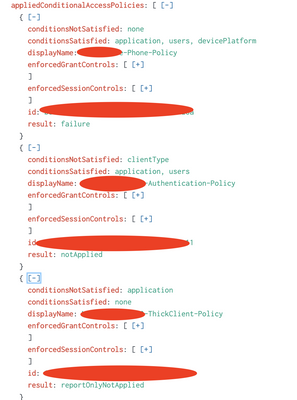
Ideal result makes this:
|stats count by appliedConditionalAccessPolicies{}.displayName AS policy_name, appliedConditionalAccessPolicies{}.result AS resultproduce something like this:
| policy_name | ||
| application_policy | failure | 12398 |
| application_policy | success | 9889898 |
| phone_policy | success | 1238988 |
- Mark as New
- Bookmark Message
- Subscribe to Message
- Mute Message
- Subscribe to RSS Feed
- Permalink
- Report Inappropriate Content

...
| spath appliedConditionalAccessPolicies{} output=appliedConditionalAccessPolicies
| stats count by appliedConditionalAccessPolicies
| spath input=appliedConditionalAccessPolicies
| table as_you_like
"stats by" is used for JSON arrays.
- Mark as New
- Bookmark Message
- Subscribe to Message
- Mute Message
- Subscribe to RSS Feed
- Permalink
- Report Inappropriate Content
...
| spath appliedConditionalAccessPolicies{} output=appliedConditionalAccessPolicies
| stats count by appliedConditionalAccessPolicies
| spath input=appliedConditionalAccessPolicies
| table as_you_like
"stats by" is used for JSON arrays.
- Mark as New
- Bookmark Message
- Subscribe to Message
- Mute Message
- Subscribe to RSS Feed
- Permalink
- Report Inappropriate Content
THANK YOU. I've been wrestling with spath for a long time and this example made a lot of things click for me. Exactly what I was looking for (and what I have been looking for when dealing with JSON for ages)
- Mark as New
- Bookmark Message
- Subscribe to Message
- Mute Message
- Subscribe to RSS Feed
- Permalink
- Report Inappropriate Content


Can you use spath to get your two mv arrays (displayName and result), then mvzip them to a new array, mvexpand that array to get new events, and do your stats on those events (perhaps splitting up the values in the new array to get displayName and result in separate columns again)?


Join the Splunk Community Slack to learn, troubleshoot, and make connections with fellow Splunk practitioners in real time!
Join Splunk User Groups to connect and learn in-person by region or remotely by topic or industry.
Think Like an Architect: Introducing the Splunk Certified Cybersecurity Defense ...
Best Practices: Splunk auto adjust pipeline queue
Announcing Modern Navigation: A New Era of Splunk User Experience
