
Turn on suggestions
Auto-suggest helps you quickly narrow down your search results by suggesting possible matches as you type.
Alerting
×
Join the Conversation
Without signing in, you're just watching from the sidelines. Sign in or Register to connect, share, and be part of the Splunk Community.
- Find Answers
- :
- Using Splunk
- :
- Other Using Splunk
- :
- Alerting
- :
- How to set an alert to find deviations from normal...
Options
- Subscribe to RSS Feed
- Mark Topic as New
- Mark Topic as Read
- Float this Topic for Current User
- Bookmark Topic
- Subscribe to Topic
- Mute Topic
- Printer Friendly Page
- Mark as New
- Bookmark Message
- Subscribe to Message
- Mute Message
- Subscribe to RSS Feed
- Permalink
- Report Inappropriate Content
How to set an alert to find deviations from normal behavior when monitoring jobs in a SQL server?

DimkoBilanko
Explorer
11-15-2016
11:25 AM
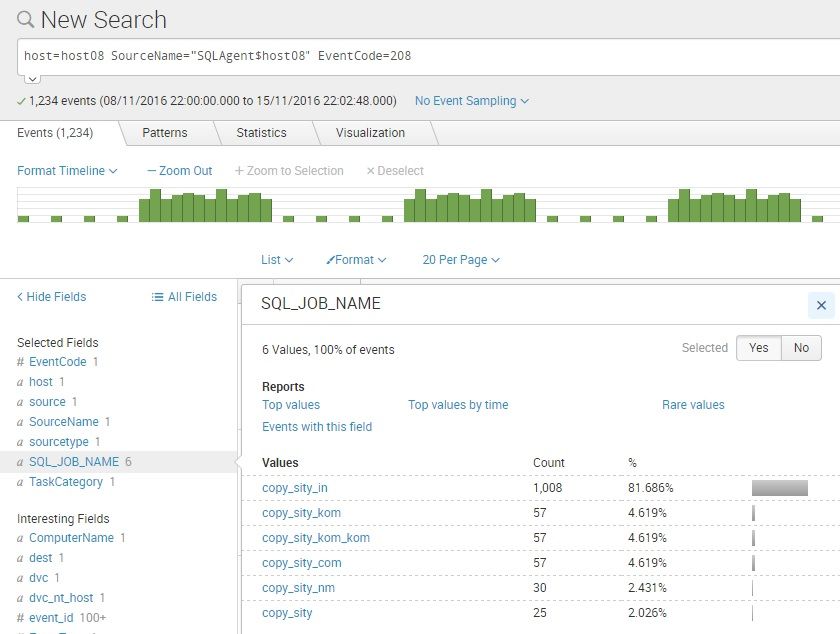
I have SQL server, where are 6 SQL jobs and it's configured to write events to Windows journal every time when job is finished (it does not matter successfully or unsuccessfully).
Normal behavior is that events appears every 5 min for one job, 15 min for another, 7 min for another and etc (duration between events can be with a small deviation).
But sometimes, jobs can halt for a long time, therefore events will not appear.....
I need to setup an alert for such incidents, i.e. find deviation from normal behavior.
- Mark as New
- Bookmark Message
- Subscribe to Message
- Mute Message
- Subscribe to RSS Feed
- Permalink
- Report Inappropriate Content

niketn
Legend
11-15-2016
11:01 PM
You can try the following which gives duration in minute for last event received for each SQL Job. You can setup alert for duration > SLA or specific JOB not found in the following result i.e. Number of Results < 6.
host=host08 SourceName="SQLAgentHost08" EventCode=208 SQL_JOB_NAME=* | stats count as Count max(_time) as LastReceived by SQL_JOB_NAME | eval LastReceivedTime=strftime(LastReceived,"%Y/%m/%d %H:%M:%S") | eval durInMin=round((now()-LastReceived)/60,1) | fields - LastReceived
____________________________________________
| makeresults | eval message= "Happy Splunking!!!"
| makeresults | eval message= "Happy Splunking!!!"



Got questions? Get answers!
Join the Splunk Community Slack to learn, troubleshoot, and make connections with fellow Splunk practitioners in real time!
Meet up IRL or virtually!
Join Splunk User Groups to connect and learn in-person by region or remotely by topic or industry.
Get Updates on the Splunk Community!
Event Series: Level up your SOC: Advancing with Splunk Enterprise Security
AI has fundamentally raised the stakes for security operations, and this three-part series is your guide to ...
Announcing Modern Navigation: A New Era of Splunk User Experience
We are excited to introduce the Modern Navigation feature in the Splunk Platform, available to both cloud and ...
SOC4Kafka - New Kafka Connector Powered by OpenTelemetry
The new SOC4Kafka connector, built on OpenTelemetry, enables the collection of Kafka messages and forwards ...
