
Join the Conversation
- Find Answers
- :
- Using Splunk
- :
- Splunk Search
- :
- Re: unable to extract all matching values in a sin...
- Subscribe to RSS Feed
- Mark Topic as New
- Mark Topic as Read
- Float this Topic for Current User
- Bookmark Topic
- Subscribe to Topic
- Mute Topic
- Printer Friendly Page
- Mark as New
- Bookmark Message
- Subscribe to Message
- Mute Message
- Subscribe to RSS Feed
- Permalink
- Report Inappropriate Content
unable to extract all matching values in a single line; the interesting field only captures first matching value.

The string is a single line, i am unable to extract all matching value in this line.
The interesting fields that Splunk has, it extracts only name1 for e.g, name2, name3 and name4 are not being extracted.
may i request your help.
SNMPVariable value='name1' (oid='enterprises.14179.2.2.1.1.3.0.39.227.7.142.160', oid_index='', snmp_type='OCTETSTR'),
SNMPVariable value='name2' (oid='enterprises.14179.2.2.1.1.3.0.163.142.226.49.48', oid_index='', snmp_type='OCTETSTR'),
SNMPVariable value='name3' (oid='enterprises.14179.2.2.1.1.3.160.35.159.93.36.0', oid_index='', snmp_type='OCTETSTR'),
SNMPVariable value='name4' (oid='enterprises.14179.2.2.1.1.3.160.35.159.93.55.112', oid_index='', snmp_type='OCTETSTR')
- Mark as New
- Bookmark Message
- Subscribe to Message
- Mute Message
- Subscribe to RSS Feed
- Permalink
- Report Inappropriate Content

Splunk's automatic field extraction only captures single valued fields. If your data has multiple values for same field, you'd need to setup custom, multivalued field extraction for the same.
One method is using fields.conf: http://docs.splunk.com/Documentation/Splunk/7.1.2/Knowledge/ConfigureSplunktoparsemulti-valuefields
Other method is using transforms.conf: https://docs.splunk.com/Documentation/Splunk/7.1.2/Knowledge/Exampleconfigurationsusingfieldtransfor...
- Mark as New
- Bookmark Message
- Subscribe to Message
- Mute Message
- Subscribe to RSS Feed
- Permalink
- Report Inappropriate Content

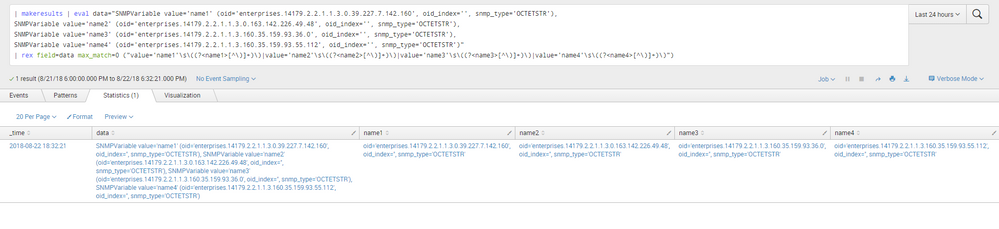
Hi @syjayaraj,
I don't believe that the name fields are static values and you are more going into a "Key-Value" extraction, but still I wanted to provide you with a solution for a static approach in splunk SPL.
| rex field=data max_match=0 ("value='name1'\s\((?<name1>[^\)]+)\)|value='name2'\s\((?<name2>[^\)]+)\)|value='name3'\s\((?<name3>[^\)]+)\)|value='name4'\s\((?<name4>[^\)]+)\)")
You might need to change the field=data to field=_raw in your case.

- Mark as New
- Bookmark Message
- Subscribe to Message
- Mute Message
- Subscribe to RSS Feed
- Permalink
- Report Inappropriate Content
Can you please be a bit more specific on the actual values that get extracted @syjayaraj.
Also I need to know if you are trying to extract this data at index-time. (when you index the data) or at search time (when you search on the data, e.g. the | rex - command)

Splunk Observability for AI
[Puzzles] Solve, Learn, Repeat: Dereferencing XML to Fixed-length events
Stay Connected: Your Guide to December Tech Talks, Office Hours, and Webinars!
