
Join the Conversation
- Find Answers
- :
- Using Splunk
- :
- Splunk Search
- :
- Re: stats, empty columns and fillnull
- Subscribe to RSS Feed
- Mark Topic as New
- Mark Topic as Read
- Float this Topic for Current User
- Bookmark Topic
- Subscribe to Topic
- Mute Topic
- Printer Friendly Page
- Mark as New
- Bookmark Message
- Subscribe to Message
- Mute Message
- Subscribe to RSS Feed
- Permalink
- Report Inappropriate Content
stats, empty columns and fillnull

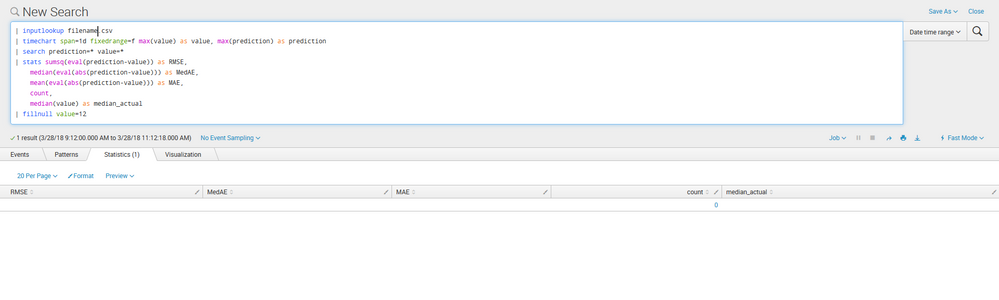
I've problems not only with fillnull in this search which doesn't fill my columns with 12. If I add "| table *" after or instead of fillnull line I'll miss my columns at all. I want save my empty columns.
Is this bug or feature? Can be problem solved without "foreach" with "isnull"?
- Mark as New
- Bookmark Message
- Subscribe to Message
- Mute Message
- Subscribe to RSS Feed
- Permalink
- Report Inappropriate Content

Hey
It is not surprising your fillnull isn't doing anything. The reason is that you filtered only the rows with prediction and value that actually are not null (by having used the *). The rows that look like having a null value are actually not null. You can recheck that with eval isnull function just to be sure.
To replace those values that look null but aren't, maybe check the length of the value and replace it by 12. But I'm assuming things, this depends on your scenario specifically speaking
- Mark as New
- Bookmark Message
- Subscribe to Message
- Mute Message
- Subscribe to RSS Feed
- Permalink
- Report Inappropriate Content
Hi
I've checked, they are null so if you will use if and isnull this is ok.. The main problem is that I miss columns if I return it from my custom command and the first line has no data in this columns. If the first line has all data this columns are ok and have empty field on several lines. When I started debugging I found upper surprise with fillnull.



Join the Splunk Community Slack to learn, troubleshoot, and make connections with fellow Splunk practitioners in real time!
Join Splunk User Groups to connect and learn in-person by region or remotely by topic or industry.
Data Management Digest – September 2026
Federated Search for CloudWatch Unified Data Store Is Generally Available
Announcing Modern Navigation: A New Era of Splunk User Experience
