
Join the Conversation
- Find Answers
- :
- Using Splunk
- :
- Splunk Search
- :
- Search for Upload Activity to Unique Domains
- Subscribe to RSS Feed
- Mark Topic as New
- Mark Topic as Read
- Float this Topic for Current User
- Bookmark Topic
- Subscribe to Topic
- Mute Topic
- Printer Friendly Page
- Mark as New
- Bookmark Message
- Subscribe to Message
- Mute Message
- Subscribe to RSS Feed
- Permalink
- Report Inappropriate Content

Hi all,
I am trying to put together a search and stats table for users in our environment who have uploaded data to a domain where there has been not been any other upload activity to that domain in the last 7 days.
Operation="FileUploadedToCloud" - I'm working with fields such as user and targetdomain.
Any help is appreciated! Thanks!
- Mark as New
- Bookmark Message
- Subscribe to Message
- Mute Message
- Subscribe to RSS Feed
- Permalink
- Report Inappropriate Content

A search like this I think will do it. (Set your search window to be last 7 days)
index=<origin_index> Operation="FileUploadedToCloud" earliest=-7d latest=now
    | stats
        count as upload_count,
        earliest(_time) as earliest_upload_epoch,
        latest(_time) as latest_upload_epoch
            by user, targetdomain
    | sort 0 -upload_count
    | stats
        dc(user) as dc_user,
        list(user) as users,
        min(earliest_upload_epoch) as earliest_upload_epoch,
        max(latest_upload_epoch) as latest_upload_epoch,
        list(upload_count) as upload_count,
        sum(upload_count) as total_upload_count
            by targetdomain
    ``` filter down results to only include domains where 1 user has uploaded in the specified search window ```
    | where 'dc_user'==1
    | convert
        ctime(earliest_upload_epoch) as earliest_upload_timestamp,
        ctime(latest_upload_epoch) as latest_upload_timestamp
    | fields - *_upload_epoch
This should also return results if a single user has uploaded to a domain multiple times but is still the only user to upload to it in the last 7 days.
Resulting dataset would look something like this.
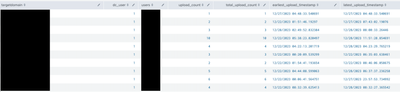
If scope needs to be narrowed to only 1 upload event by a user then you can additional filter to only return the events where 'total_upload_count'==1
- Mark as New
- Bookmark Message
- Subscribe to Message
- Mute Message
- Subscribe to RSS Feed
- Permalink
- Report Inappropriate Content
A search like this I think will do it. (Set your search window to be last 7 days)
index=<origin_index> Operation="FileUploadedToCloud" earliest=-7d latest=now
    | stats
        count as upload_count,
        earliest(_time) as earliest_upload_epoch,
        latest(_time) as latest_upload_epoch
            by user, targetdomain
    | sort 0 -upload_count
    | stats
        dc(user) as dc_user,
        list(user) as users,
        min(earliest_upload_epoch) as earliest_upload_epoch,
        max(latest_upload_epoch) as latest_upload_epoch,
        list(upload_count) as upload_count,
        sum(upload_count) as total_upload_count
            by targetdomain
    ``` filter down results to only include domains where 1 user has uploaded in the specified search window ```
    | where 'dc_user'==1
    | convert
        ctime(earliest_upload_epoch) as earliest_upload_timestamp,
        ctime(latest_upload_epoch) as latest_upload_timestamp
    | fields - *_upload_epoch
This should also return results if a single user has uploaded to a domain multiple times but is still the only user to upload to it in the last 7 days.
Resulting dataset would look something like this.
If scope needs to be narrowed to only 1 upload event by a user then you can additional filter to only return the events where 'total_upload_count'==1
- Mark as New
- Bookmark Message
- Subscribe to Message
- Mute Message
- Subscribe to RSS Feed
- Permalink
- Report Inappropriate Content
This is perfect. Thank you!
- Mark as New
- Bookmark Message
- Subscribe to Message
- Mute Message
- Subscribe to RSS Feed
- Permalink
- Report Inappropriate Content


If your problem is resolved, then please click an "Accept as Solution" button to help future readers.
If this reply helps you, Karma would be appreciated.
- Mark as New
- Bookmark Message
- Subscribe to Message
- Mute Message
- Subscribe to RSS Feed
- Permalink
- Report Inappropriate Content
Search over the last 7 days and count entries by target domain. Filter out anything with a count greater than 1.
index=foo Operation=FileUploadedToCloud user=* targetdomain=* earliest=-7d
| stats count, values(*) as * by targetdomain
| where count=1If this reply helps you, Karma would be appreciated.

Accelerating Observability as Code with the Splunk AI Assistant
Integrating Splunk Search API and Quarto to Create Reproducible Investigation ...
Congratulations to the 2025-2026 SplunkTrust!
