
Join the Conversation
- Find Answers
- :
- Using Splunk
- :
- Splunk Search
- :
- Re: Regex to extract email domain name
- Subscribe to RSS Feed
- Mark Topic as New
- Mark Topic as Read
- Float this Topic for Current User
- Bookmark Topic
- Subscribe to Topic
- Mute Topic
- Printer Friendly Page
- Mark as New
- Bookmark Message
- Subscribe to Message
- Mute Message
- Subscribe to RSS Feed
- Permalink
- Report Inappropriate Content

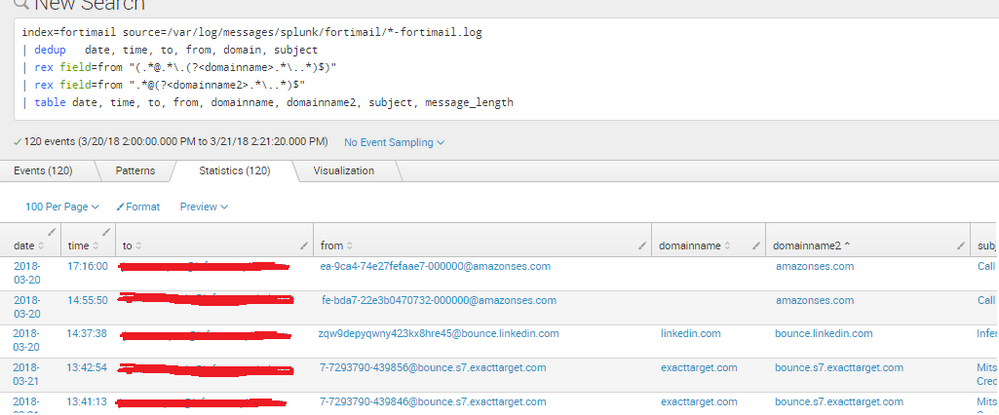
I have two regexes below which are pulling the domain name of the email sender (from). i.e linkedin.com, amazones.com.
However I cant create one regex to pull them both in one as they aren't always in the same format.
index=fortimail source=/var/log/messages/splunk/fortimail/*-fortimail.log
| dedup   date, time, to, from, domain, subject
| rex field=from "(.*@.*\.(?<domainname>.*\..*)$)"
| rex field=from ".*@(?<domainname2>.*\..*)$"
| table date, time, to, from, domainname, domainname2, subject, message_length

- Mark as New
- Bookmark Message
- Subscribe to Message
- Mute Message
- Subscribe to RSS Feed
- Permalink
- Report Inappropriate Content

This should work with any domain (not just .com):
rex field=from ".*?(?<domainname>[\w]+\.[\w]+)$"
Edit:
Example - https://regex101.com/r/1uTWmD/1/
- Mark as New
- Bookmark Message
- Subscribe to Message
- Mute Message
- Subscribe to RSS Feed
- Permalink
- Report Inappropriate Content

Try this generic example
| makeresults
| eval to="tiago@lalala.domain1.com"
| append [ | makeresults
| eval to="tiago@domain2.com" ]
| append [ | makeresults | eval to="firstname.surname@test.co.uk" ]
| rex field=to "@(.*\.)*(?<Domain>.*\..*)"
The test.co.uk is an outlier to this rule? Did you want domain to be test.co.uk? Then you have the same exact format but you want two different behaviours?
Regex doesn't work like that
- Mark as New
- Bookmark Message
- Subscribe to Message
- Mute Message
- Subscribe to RSS Feed
- Permalink
- Report Inappropriate Content
This should work with any domain (not just .com):
rex field=from ".*?(?<domainname>[\w]+\.[\w]+)$"
Edit:
Example - https://regex101.com/r/1uTWmD/1/
- Mark as New
- Bookmark Message
- Subscribe to Message
- Mute Message
- Subscribe to RSS Feed
- Permalink
- Report Inappropriate Content
It doesn't work with this example: firstname.surname@test.co.uk
Any thoughts?
- Mark as New
- Bookmark Message
- Subscribe to Message
- Mute Message
- Subscribe to RSS Feed
- Permalink
- Report Inappropriate Content
This is a generically difficult problem. Differentiating domains from subdomains requires a priori knowledge of all top level domains (TLDs), because a domain is really just something.valid-tld, where something is composed of letters, numbers, and hyphens (if the hyphens are surrounded on both sides by letters, numbers, or other hypens; hyphens may not be the first or last character in a domain name).
To that end, you could build something yourself that does this, but you'd be reinventing the wheel. You might want to check out this blog post on UT_parsing, which describes a few Splunk add-ons/apps that you could leverage in your work.
- Mark as New
- Bookmark Message
- Subscribe to Message
- Mute Message
- Subscribe to RSS Feed
- Permalink
- Report Inappropriate Content
Thank you! Yes i thought I was maybe over complicating it.

Data Management Digest – December 2025
Index This | What is broken 80% of the time by February?
Unlock Faster Time-to-Value on Edge and Ingest Processor with New SPL2 Pipeline ...
