
Join the Conversation
- Find Answers
- :
- Using Splunk
- :
- Splunk Search
- :
- How to loop through the record to get the diff bet...
- Subscribe to RSS Feed
- Mark Topic as New
- Mark Topic as Read
- Float this Topic for Current User
- Bookmark Topic
- Subscribe to Topic
- Mute Topic
- Printer Friendly Page
- Mark as New
- Bookmark Message
- Subscribe to Message
- Mute Message
- Subscribe to RSS Feed
- Permalink
- Report Inappropriate Content

Hi there,
I am trying to diff the new version against the one version older record and extract the diff from them.
For example,
ver 1.3 against 1.2 and ver 1.2 against 1.1 to only extract the diff between them.
I hope to do it in a flexible ways as in future I may have ver 1.4 and so on...
I also want to limit the results to only latest 5 version diff.
For example,
I got 1.1, 1.2, ..., 1.10 version, but I only want the result for 1.6, 1.7, ..., 1.10 when diff against the previous one version.
Is that possible?
Currently I have data like this:
records:
============================================
index=a, ver=1.1, a="halo", b="haha", c="nana"
index=a, ver=1.1, a="testing", b="haha", c="nana"
index=a, ver=1.1, a="halo", b="kaka", c="testing"
index=a, ver=1.2, a="halo", b="haha", c="nana"
index=a, ver=1.2, a="lala", b="haha", c="nana"
index=a, ver=1.2, a="halo", b="kaka", c="TESTING"
index=a, ver=1.3, a="halo", b="haha", c="nana"
index=a, ver=1.3, a="lala", b="haha", c="tata"
index=a, ver=1.3, a="halo", b="kaka", c="lala"
index=a, ver=1.3, a="halo", b="kaka", c="kakaka"
============================================
Result expected when comparing ver 1.2 against 1.1 and ver1.3 against 1.2:
| ver | added record (merging a b c using ",") | removed record (merging a b c using ",") |
| 1.2 | lala,haha,nana halo,kaka,TESTING | testing,haha,nana halo,kaka,testing |
| 1.3 | lala,haha,tata halo,kaka,lala halo,kaka,kakaka | lala,haha,nana halo,kaka,TESTING |
- Mark as New
- Bookmark Message
- Subscribe to Message
- Mute Message
- Subscribe to RSS Feed
- Permalink
- Report Inappropriate Content


| makeresults
| eval _raw="index=a, ver=1.1, a=\"halo\", b=\"haha\", c=\"nana\"

index=a, ver=1.1, a=\"testing\", b=\"haha\", c=\"nana\"

index=a, ver=1.1, a=\"halo\", b=\"kaka\", c=\"testing\"

index=a, ver=1.2, a=\"halo\", b=\"haha\", c=\"nana\"

index=a, ver=1.2, a=\"lala\", b=\"haha\", c=\"nana\"

index=a, ver=1.2, a=\"halo\", b=\"kaka\", c=\"TESTING\"

index=a, ver=1.3, a=\"halo\", b=\"haha\", c=\"nana\"

index=a, ver=1.3, a=\"lala\", b=\"haha\", c=\"tata\"

index=a, ver=1.3, a=\"halo\", b=\"kaka\", c=\"lala\"

index=a, ver=1.3, a=\"halo\", b=\"kaka\", c=\"kakaka\""
| multikv noheader=t
| table _raw


| kv
| streamstats count as row by ver
| sort 0 row ver
| streamstats list(a) as previous_a list(b) as previous_b list(c) as previous_c window=1 current=f by row
| where ver!="1.1"
| where a!=previous_a OR b!=previous_b OR c!=previous_c OR isnull(previous_a) OR isnull(previous_b) OR isnull(previous_c)
| sort 0 ver row
| eval added=a.",".b.",".c
| eval removed=previous_a.",".previous_b.",".previous_c
| stats list(added) as added list(removed) as removed by ver- Mark as New
- Bookmark Message
- Subscribe to Message
- Mute Message
- Subscribe to RSS Feed
- Permalink
- Report Inappropriate Content
Thanks for pointing out, I have updated the post.
You seem to be comparing the first event in version 1.1 with the first event in version 1.2, and the second event in version 1.1 with the second event in version 1.2, and so on. Is this correct?
Ya, I am comparing version 1.2 against 1.1 then 1.3 against 1.2.
Is there some other way to identify which events should be compared against each other?
No other way. Not sure is it possible to use mvindex to get list of uniq version then do zipping like below and compare against each other.
[(1.2, 1.1)
(1.3, 1.2)]
- Mark as New
- Bookmark Message
- Subscribe to Message
- Mute Message
- Subscribe to RSS Feed
- Permalink
- Report Inappropriate Content
| makeresults
| eval _raw="index=a, ver=1.1, a=\"halo\", b=\"haha\", c=\"nana\"

index=a, ver=1.1, a=\"testing\", b=\"haha\", c=\"nana\"

index=a, ver=1.1, a=\"halo\", b=\"kaka\", c=\"testing\"

index=a, ver=1.2, a=\"halo\", b=\"haha\", c=\"nana\"

index=a, ver=1.2, a=\"lala\", b=\"haha\", c=\"nana\"

index=a, ver=1.2, a=\"halo\", b=\"kaka\", c=\"TESTING\"

index=a, ver=1.3, a=\"halo\", b=\"haha\", c=\"nana\"

index=a, ver=1.3, a=\"lala\", b=\"haha\", c=\"tata\"

index=a, ver=1.3, a=\"halo\", b=\"kaka\", c=\"lala\"

index=a, ver=1.3, a=\"halo\", b=\"kaka\", c=\"kakaka\""
| multikv noheader=t
| table _raw


| kv
| streamstats count as row by ver
| sort 0 row ver
| streamstats list(a) as previous_a list(b) as previous_b list(c) as previous_c window=1 current=f by row
| where ver!="1.1"
| where a!=previous_a OR b!=previous_b OR c!=previous_c OR isnull(previous_a) OR isnull(previous_b) OR isnull(previous_c)
| sort 0 ver row
| eval added=a.",".b.",".c
| eval removed=previous_a.",".previous_b.",".previous_c
| stats list(added) as added list(removed) as removed by ver- Mark as New
- Bookmark Message
- Subscribe to Message
- Mute Message
- Subscribe to RSS Feed
- Permalink
- Report Inappropriate Content
Hi ITWhisperer,
Thanks for your respond but not sure why the result is empty after I run it.
Can you help to confirm?
- Mark as New
- Bookmark Message
- Subscribe to Message
- Mute Message
- Subscribe to RSS Feed
- Permalink
- Report Inappropriate Content
Here is a screenshot of it working
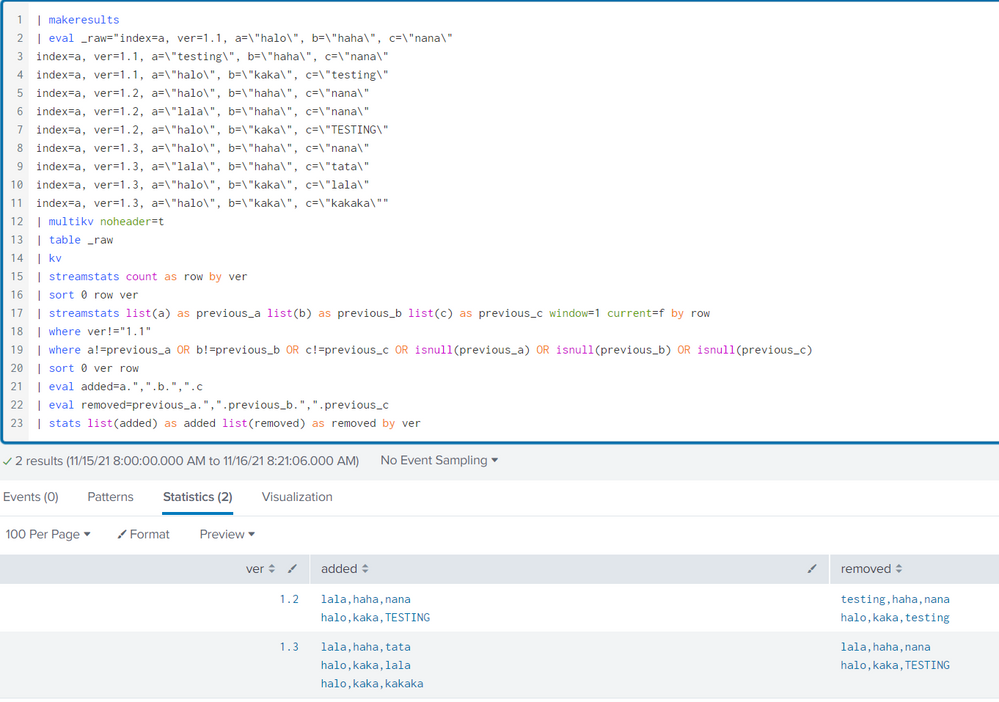
What are you doing differently?
- Mark as New
- Bookmark Message
- Subscribe to Message
- Mute Message
- Subscribe to RSS Feed
- Permalink
- Report Inappropriate Content
Hi ITWhisperer,
Not sure why after I copy again and paste it to the search engine.
It is working as expected.
Thank for your help 🙂
- Mark as New
- Bookmark Message
- Subscribe to Message
- Mute Message
- Subscribe to RSS Feed
- Permalink
- Report Inappropriate Content
Are these separate events in splunk?
You seem to be comparing the first event in version 1.1 with the first event in version 1.2, and the second event in version 1.1 with the second event in version 1.2, and so on. Is this correct? Is there some other way to identify which events should be compared against each other?
Why does lala, haha, tata not feature as an addition in version 1.3 since it doesn't appear in version 1.2?


Join the Splunk Community Slack to learn, troubleshoot, and make connections with fellow Splunk practitioners in real time!
Join Splunk User Groups to connect and learn in-person by region or remotely by topic or industry.
Data Management Digest – September 2026
Federated Search for CloudWatch Unified Data Store Is Generally Available
Announcing Modern Navigation: A New Era of Splunk User Experience
