
Turn on suggestions
Auto-suggest helps you quickly narrow down your search results by suggesting possible matches as you type.
Splunk Search
×
Join the Conversation
Without signing in, you're just watching from the sidelines. Sign in or Register to connect, share, and be part of the Splunk Community.
- Find Answers
- :
- Using Splunk
- :
- Splunk Search
- :
- How to convert row values into fields with count?
Options
- Subscribe to RSS Feed
- Mark Topic as New
- Mark Topic as Read
- Float this Topic for Current User
- Bookmark Topic
- Subscribe to Topic
- Mute Topic
- Printer Friendly Page
- Mark as New
- Bookmark Message
- Subscribe to Message
- Mute Message
- Subscribe to RSS Feed
- Permalink
- Report Inappropriate Content

cindywee
New Member
08-22-2019
12:22 PM
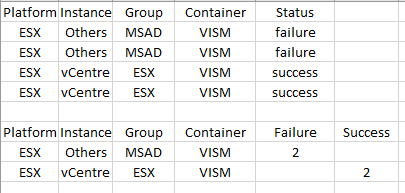
Hi. How do I get from the first table to look like the second table?
I have tried chart, transpose, different combination of eval and stats functions but just cannot get it to look right. I am working off a csv data set.

1 Solution
- Mark as New
- Bookmark Message
- Subscribe to Message
- Mute Message
- Subscribe to RSS Feed
- Permalink
- Report Inappropriate Content

solarboyz1
Builder
08-22-2019
12:28 PM
Add the following to the search you used to generate the first table:
| stats sum(eval(if(status="failure",1,0)) as Failure, sum(eval(if(status="success",1,0)) as Success by Platform, Instance, Group, Container
https://docs.splunk.com/Documentation/Splunk/7.3.1/Search/Usestatswithevalexpressionsandfunctions
- Mark as New
- Bookmark Message
- Subscribe to Message
- Mute Message
- Subscribe to RSS Feed
- Permalink
- Report Inappropriate Content
cindywee
New Member
08-22-2019
12:47 PM
You are a genius. The most simple solution is always to right solution.
- Mark as New
- Bookmark Message
- Subscribe to Message
- Mute Message
- Subscribe to RSS Feed
- Permalink
- Report Inappropriate Content
solarboyz1
Builder
08-22-2019
12:28 PM
Add the following to the search you used to generate the first table:
| stats sum(eval(if(status="failure",1,0)) as Failure, sum(eval(if(status="success",1,0)) as Success by Platform, Instance, Group, Container
https://docs.splunk.com/Documentation/Splunk/7.3.1/Search/Usestatswithevalexpressionsandfunctions

Got questions? Get answers!
Join the Splunk Community Slack to learn, troubleshoot, and make connections with fellow Splunk practitioners in real time!
Meet up IRL or virtually!
Join Splunk User Groups to connect and learn in-person by region or remotely by topic or industry.
Get Updates on the Splunk Community!
Make Your Machine Data AI-Ready in Splunk
Every team is getting ready for AI agents.
Thursday, November 12, 2026 | 11AM PST / 2PM EST
...
Splunk Asynchronous Forwarding Explained
Splunk asynchronous forwarding is often misunderstood as simply setting autoLBVolume. That is not quite right. ...
How to Monitor AI Agents with Splunk Agent Observability
Let’s say I’m running a travel planning AI app in production. A user asks for three concise hotel options in ...
