
Join the Conversation
- Find Answers
- :
- Using Splunk
- :
- Splunk Search
- :
- Re: how to calculate Uptime
- Subscribe to RSS Feed
- Mark Topic as New
- Mark Topic as Read
- Float this Topic for Current User
- Bookmark Topic
- Subscribe to Topic
- Mute Topic
- Printer Friendly Page
- Mark as New
- Bookmark Message
- Subscribe to Message
- Mute Message
- Subscribe to RSS Feed
- Permalink
- Report Inappropriate Content
How to calculate Uptime?

Splukers,
I want to calculate uptime for my network. By this I mean, I need uptime in hours like time diffrence between to consecutive uptimes and downtimes.

As in above image, I want to calculate uptime and downtime but not total. for example my network was up for two hours and there was downtime for 15 mins and then network is up for 4 hours and then again experience downtime for 10 mins. I want to achieve this. How can I do this stuff in SPL
- Mark as New
- Bookmark Message
- Subscribe to Message
- Mute Message
- Subscribe to RSS Feed
- Permalink
- Report Inappropriate Content
- Mark as New
- Bookmark Message
- Subscribe to Message
- Mute Message
- Subscribe to RSS Feed
- Permalink
- Report Inappropriate Content
Is this post is being viewed.. Anyone help me here?
- Mark as New
- Bookmark Message
- Subscribe to Message
- Mute Message
- Subscribe to RSS Feed
- Permalink
- Report Inappropriate Content


Your question is not clear with respect to events you shared. Can you elaborate little bit with example.
If this helps, give a like below.
- Mark as New
- Bookmark Message
- Subscribe to Message
- Mute Message
- Subscribe to RSS Feed
- Permalink
- Report Inappropriate Content
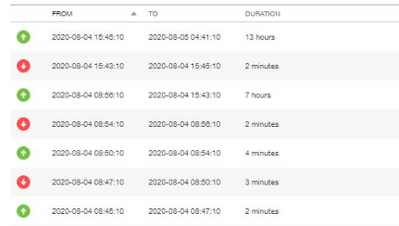
Yeah!! actually I want to monitor my public IP.. let's say google.. so I am pinging that IP..
and saving those into txt file. Then I am inserting those txt files into splunk.
Now, Network might be Up for like 3 hours and down for next 10 min and then again up for 2 hours.
so what is want as per below image.. Instead of arrow you can count it up and down
- Mark as New
- Bookmark Message
- Subscribe to Message
- Mute Message
- Subscribe to RSS Feed
- Permalink
- Report Inappropriate Content
I believe there are many dest in your events. You want to get this report per dest?
If this helps, give a like below.
- Mark as New
- Bookmark Message
- Subscribe to Message
- Mute Message
- Subscribe to RSS Feed
- Permalink
- Report Inappropriate Content
yes! i have configured drill down to each dest. So i want it on the dril down page..


Join the Splunk Community Slack to learn, troubleshoot, and make connections with fellow Splunk practitioners in real time!
Join Splunk User Groups to connect and learn in-person by region or remotely by topic or industry.
Persistent Queue at TcpOut — One of Splunk's Most Practical Features
Skip the Awkward Silence: Have a .conf-ersation at .conf26
Rethinking Zero Trust: From Product Purchases to Logical Control Evidence
