
Join the Conversation
- Find Answers
- :
- Using Splunk
- :
- Splunk Search
- :
- Re: How scheduling works?
- Subscribe to RSS Feed
- Mark Topic as New
- Mark Topic as Read
- Float this Topic for Current User
- Bookmark Topic
- Subscribe to Topic
- Mute Topic
- Printer Friendly Page
- Mark as New
- Bookmark Message
- Subscribe to Message
- Mute Message
- Subscribe to RSS Feed
- Permalink
- Report Inappropriate Content

Hi,
I have a scheduled search that runs every 1 minute and it searches events on last 1 minute.
Will this search cover all future events?
If the search could start (for example) at 5:07:05 and than at 5:08:07 - are the data from (5:07:05 - 5:07:07) lost?
- Mark as New
- Bookmark Message
- Subscribe to Message
- Mute Message
- Subscribe to RSS Feed
- Permalink
- Report Inappropriate Content

Hi lukasz92,
there is a solution to your problem.
Try to apply the following settings to your alert
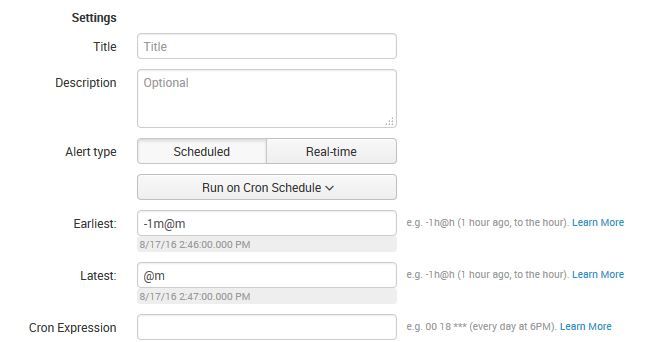
This will asure, that everything from 02:46:00 to 02:47:00 is covered. The alert is able to run between 02:47:00 and 02:47:59 and will still catch the data.
BUT, splunk takes time to index data... so data that reaches the machine on 02:46:59 might not be indexed by 02:47:00... so you should try to make like a little "window" for your alert to run in... do that in the Cron-Expression field.
- Mark as New
- Bookmark Message
- Subscribe to Message
- Mute Message
- Subscribe to RSS Feed
- Permalink
- Report Inappropriate Content
Hi lukasz92,
there is a solution to your problem.
Try to apply the following settings to your alert
This will asure, that everything from 02:46:00 to 02:47:00 is covered. The alert is able to run between 02:47:00 and 02:47:59 and will still catch the data.
BUT, splunk takes time to index data... so data that reaches the machine on 02:46:59 might not be indexed by 02:47:00... so you should try to make like a little "window" for your alert to run in... do that in the Cron-Expression field.
- Mark as New
- Bookmark Message
- Subscribe to Message
- Mute Message
- Subscribe to RSS Feed
- Permalink
- Report Inappropriate Content
it is a great solution. I have not thought about "@m".
Thanks!
- Mark as New
- Bookmark Message
- Subscribe to Message
- Mute Message
- Subscribe to RSS Feed
- Permalink
- Report Inappropriate Content
Glad to help! 🙂
- Mark as New
- Bookmark Message
- Subscribe to Message
- Mute Message
- Subscribe to RSS Feed
- Permalink
- Report Inappropriate Content

What are you trying to accomplish with your scheduled search? Do you have an alert tied to this scheduled search?
You set the time window for 1 minute, so technically the data is not "lost", but the data is not available in your 1 minute window if it's older than 1 minute
- Mark as New
- Bookmark Message
- Subscribe to Message
- Mute Message
- Subscribe to RSS Feed
- Permalink
- Report Inappropriate Content
Yes, Something like searching for custom events and alerting.
Technically I agree and understand - my question was about practice: how this does actually work.



Join the Splunk Community Slack to learn, troubleshoot, and make connections with fellow Splunk practitioners in real time!
Join Splunk User Groups to connect and learn in-person by region or remotely by topic or industry.
At .conf26, Don’t Just See What’s Next. Help Shape It at Innovation Labs.
Forwarder Topology Guidance: Intermediate HF vs Intermediate UF
Data Management Digest – August 2026
