
Join the Conversation
- Find Answers
- :
- Using Splunk
- :
- Splunk Search
- :
- Re: How can we exclude rows which are present in a...
- Subscribe to RSS Feed
- Mark Topic as New
- Mark Topic as Read
- Float this Topic for Current User
- Bookmark Topic
- Subscribe to Topic
- Mute Topic
- Printer Friendly Page
- Mark as New
- Bookmark Message
- Subscribe to Message
- Mute Message
- Subscribe to RSS Feed
- Permalink
- Report Inappropriate Content

Hi,
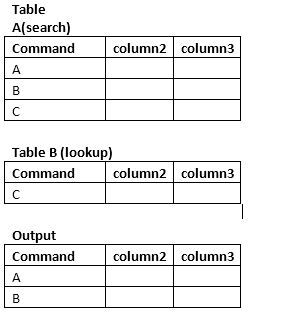
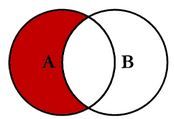
I am using one search query to extract list of data and I want to exclude those rows which are present in one csv file(lookup).
- Mark as New
- Bookmark Message
- Subscribe to Message
- Mute Message
- Subscribe to RSS Feed
- Permalink
- Report Inappropriate Content

@agoyal, refer to @somesoni2's answer https://answers.splunk.com/answers/612603/how-to-search-what-values-are-missing-in-my-lookup.html of marking the results coming from index vs lookup and then you can add a filter to only those coming from index.
Following is a run anywhere example (instead of first pipe | tstats you can have your first search pulling data from index)
| tstats count where index=_internal by sourcetype
| eval from="data"
| append[ | inputlookup sourcetypelist.csv
    | table sourcetype
    | eval count=0
    | eval from="lookup"]
| stats values(from) as from sum(count) as Total by sourcetype
| search from="data" AND from!="lookup"
You can also use outer join (or left) with |inputlookup as your first command and index search as second.
| makeresults | eval message= "Happy Splunking!!!"
- Mark as New
- Bookmark Message
- Subscribe to Message
- Mute Message
- Subscribe to RSS Feed
- Permalink
- Report Inappropriate Content

Generally, in this type of cases, you can just use lookup table to filter your data upfront, so that all you get is data no in lookup, like this
your base search NOT [| inputlookup yourlookup.csv | table Fields For Filter]
|..aggregation commans...
- Mark as New
- Bookmark Message
- Subscribe to Message
- Mute Message
- Subscribe to RSS Feed
- Permalink
- Report Inappropriate Content
@somesoni2: thank you !! my base search(tstats) display results in table. Not sure how to use "NOT" after that.
- Mark as New
- Bookmark Message
- Subscribe to Message
- Mute Message
- Subscribe to RSS Feed
- Permalink
- Report Inappropriate Content
@agoyal , by base search @somesoni2 meant the first pipe with index and sourcetype where you will apply
second search for field values not in the lookup file i.e. NOT [| inputlookup ....]
Unless your main search is on metadata fields, this is better approach where your events can be filtered in the base search itself. So do try out this approach (if your main query is not tstats) and confirm query performance.
PS: Table generating command or transforming commands can be placed only after your base search.
| makeresults | eval message= "Happy Splunking!!!"
- Mark as New
- Bookmark Message
- Subscribe to Message
- Mute Message
- Subscribe to RSS Feed
- Permalink
- Report Inappropriate Content
Thank you for clarification. my main query is tstats. Other approach with append fits for my requirement. Thanks Again 🙂
- Mark as New
- Bookmark Message
- Subscribe to Message
- Mute Message
- Subscribe to RSS Feed
- Permalink
- Report Inappropriate Content
@agoyal, refer to @somesoni2's answer https://answers.splunk.com/answers/612603/how-to-search-what-values-are-missing-in-my-lookup.html of marking the results coming from index vs lookup and then you can add a filter to only those coming from index.
Following is a run anywhere example (instead of first pipe | tstats you can have your first search pulling data from index)
| tstats count where index=_internal by sourcetype
| eval from="data"
| append[ | inputlookup sourcetypelist.csv
    | table sourcetype
    | eval count=0
    | eval from="lookup"]
| stats values(from) as from sum(count) as Total by sourcetype
| search from="data" AND from!="lookup"
You can also use outer join (or left) with |inputlookup as your first command and index search as second.
| makeresults | eval message= "Happy Splunking!!!"
- Mark as New
- Bookmark Message
- Subscribe to Message
- Mute Message
- Subscribe to RSS Feed
- Permalink
- Report Inappropriate Content
Thank you @niketnilay @somesoni2 . It worked for me. 🙂




Join the Splunk Community Slack to learn, troubleshoot, and make connections with fellow Splunk practitioners in real time!
Join Splunk User Groups to connect and learn in-person by region or remotely by topic or industry.
Free Professional Services for .conf26 Attendees
Defend at Machine Speed: Your Guide to Security Sessions at .conf26
Where Innovation Takes Flight: The Splunk4Aviation Flight Sim Lands at .conf26
