
Turn on suggestions
Auto-suggest helps you quickly narrow down your search results by suggesting possible matches as you type.
Splunk Search
×
Join the Conversation
Without signing in, you're just watching from the sidelines. Sign in or Register to connect, share, and be part of the Splunk Community.
- Find Answers
- :
- Using Splunk
- :
- Splunk Search
- :
- Brute Force Query Help
Options
- Subscribe to RSS Feed
- Mark Topic as New
- Mark Topic as Read
- Float this Topic for Current User
- Bookmark Topic
- Subscribe to Topic
- Mute Topic
- Printer Friendly Page
- Mark as New
- Bookmark Message
- Subscribe to Message
- Mute Message
- Subscribe to RSS Feed
- Permalink
- Report Inappropriate Content
Brute Force Query Help

alanzchan
Path Finder
08-03-2020
08:26 AM
I am trying to mimic the table below. I have the count of the source IP, but how do I get the count of the respective subnets? In the example, they have it in the cell of each subnet value. Here is what I have so far:
index=xxxx sourcetype=xxxx "xxxx"
| eval ERROR_CODE=case((RC="200"), "Success", (RC="400"), "User Not Found",(RC="401") , "Bad Password",(RC="500"), "Internal Server Error")
| rex field=_raw "TCIP='(?<subnet_24>\d+\.\d+\.\d+)\.\d+"
| rex field=_raw "TCIP='(?<subnet_16>\d+\.\d+)\.\d+\.\d+"
| eval subnet_24 = subnet_24 +".x"
| eval subnet_16 = subnet_16 +".x.x"
| stats count(TCIP) by subnet_24 subnet_16 TCIP
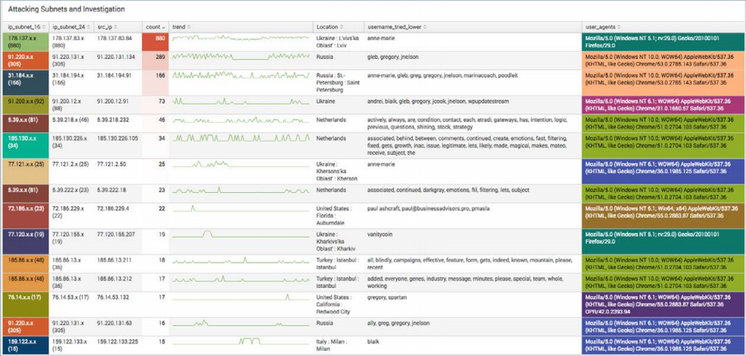
Any help is appreciated!
- Mark as New
- Bookmark Message
- Subscribe to Message
- Mute Message
- Subscribe to RSS Feed
- Permalink
- Report Inappropriate Content

isoutamo

SplunkTrust
08-03-2020
09:30 AM
Hi
you should try eventstats instead of stats.
r. Ismo


Got questions? Get answers!
Join the Splunk Community Slack to learn, troubleshoot, and make connections with fellow Splunk practitioners in real time!
Meet up IRL or virtually!
Join Splunk User Groups to connect and learn in-person by region or remotely by topic or industry.
Get Updates on the Splunk Community!
SOC4Kafka - New Kafka Connector Powered by OpenTelemetry
The new SOC4Kafka connector, built on OpenTelemetry, enables the collection of Kafka messages and forwards ...
Rounding off the Splunk Dashboard Contest
What does a contest-winning Splunk dashboard look like? In this case, it isn't in a browser tab at all. It ...
A Four Part Event Series: AI + Observability: AI Agents, LLMs, Apps, & Infrastructure
AI + Observability: AI Agents, LLMs, Apps, & Infrastructure
The rapid evolution of artificial intelligence ...
