
Turn on suggestions
Auto-suggest helps you quickly narrow down your search results by suggesting possible matches as you type.
Splunk Enterprise
×
Join the Conversation
Without signing in, you're just watching from the sidelines. Sign in or Register to connect, share, and be part of the Splunk Community.
- Find Answers
- :
- Splunk Products
- :
- Splunk Enterprise
- :
- Merge Data per timestamp
Options
- Subscribe to RSS Feed
- Mark Topic as New
- Mark Topic as Read
- Float this Topic for Current User
- Bookmark Topic
- Subscribe to Topic
- Mute Topic
- Printer Friendly Page
- Mark as New
- Bookmark Message
- Subscribe to Message
- Mute Message
- Subscribe to RSS Feed
- Permalink
- Report Inappropriate Content

robertlynch2020
Influencer
10-12-2021
08:33 AM
I am pulling data from multiple locations and a new field threshold has been introduced.
The issue is threshold is common but has different values depending if it is cpuPerc or memoryCons etc.. There are 4 of them.
| mstats min("mx.process.cpu.utilization") as cpuPerc min("mx.process.threads") as nbOfThreads min("mx.process.memory.usage") as memoryCons min("mx.process.file_descriptors") as nbOfOpenFiles min("mx.process.up.time") as upTime avg("mx.process.creation.time") as creationTime WHERE "index"="metrics_test" AND mx.env=http://mx20267vm:15000 span=10s BY pid cmd service.type host.name service.name replica.name component.name threshold
On option I have if i want to display all the thresholds differently is to write a 3 joins - but this is heavy on CPU.
| mstats min("mx.process.cpu.utilization") as cpuPerc WHERE "index"="metrics_test" AND mx.env=http://mx20267vm:15000 span=10s BY pid cmd service.type host.name service.name replica.name component.name threshold
| rename service.name as service_name
| rename threshold as T_cpuPerc
| join _time service.name replica.name
    [| mstats min("mx.process.threads") as nbOfThreads WHERE "index"="metrics_test" AND mx.env=http://mx20267vm:15000 span=10s BY pid cmd service.type host.name service.name replica.name component.name threshold
    | rename service.name as service_name
    | rename threshold as T_nbOfThreads ]
| join _time service.name replica.name
    [| mstats min("mx.process.memory.usage") as memoryCons WHERE "index"="metrics_test" AND mx.env=http://mx20267vm:15000 span=10s BY pid cmd service.type host.name service.name replica.name component.name threshold
    | rename service.name as service_name
    | rename threshold as T_memoryCons ]
| join _time service.name replica.name
    [| mstats min("mx.process.file_descriptors") as nbOfOpenFiles WHERE "index"="metrics_test" AND mx.env=http://mx20267vm:15000 span=10s BY pid cmd service.type host.name service.name replica.name component.name threshold
    | rename service.name as service_name
    | rename threshold as T_nbOfOpenFiles ]
I am trying this way but I am not sure how to merge the rows by time in the end - any ideas.
| mstats min("mx.process.cpu.utilization") as cpuPerc min("mx.process.threads") as nbOfThreads min("mx.process.memory.usage") as memoryCons min("mx.process.file_descriptors") as nbOfOpenFiles min("mx.process.up.time") as upTime avg("mx.process.creation.time") as creationTime WHERE "index"="metrics_test" AND mx.env=http://mx20267vm:15000 span=10s BY pid cmd service.type host.name service.name replica.name component.name threshold
| rename service.name as service_name
| search service_name IN (*cache*)
| eval threshold_nbOfThreads=if(isnull(nbOfThreads),"",$threshold$)
| eval threshold_memoryCons=if(isnull(memoryCons),"",$threshold$)
| eval threshold_nbOfOpenFiles=if(isnull(nbOfOpenFiles),"",$threshold$)
| table _time threshold threshold_nbOfOpenFiles threshold_memoryCons threshold_nbOfThreads
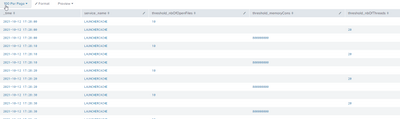
The issue is the data is now on different rows - where I need them to be on the same by _time.
SO in the image below, we have 3 lines for each time. How can i get them to merge per timestamp?
1 Solution
- Mark as New
- Bookmark Message
- Subscribe to Message
- Mute Message
- Subscribe to RSS Feed
- Permalink
- Report Inappropriate Content
robertlynch2020
Influencer
10-12-2021
08:37 AM
Got it with stats at the end -
| mstats min("mx.process.threads") as nbOfThreads min("mx.process.memory.usage") as memoryCons min("mx.process.file_descriptors") as nbOfOpenFiles WHERE "index"="metrics_test" AND mx.env=http://mx20267vm:15000 span=10s BY pid cmd service.type host.name service.name replica.name component.name threshold
| rename service.name as service_name
| search service_name IN (*cache*)
| eval threshold_nbOfThreads=if(isnull(nbOfThreads),"",$threshold$)
| eval threshold_memoryCons=if(isnull(memoryCons),"",$threshold$)
| eval threshold_nbOfOpenFiles=if(isnull(nbOfOpenFiles),"",$threshold$)
| table _time service_name threshold_nbOfOpenFiles threshold_memoryCons threshold_nbOfThreads
| stats values(threshold_nbOfOpenFiles) as threshold_nbOfOpenFiles values(threshold_memoryCons) as threshold_memoryCons values(threshold_nbOfThreads) as threshold_nbOfThreads by _time service_name
Thanks to
- Mark as New
- Bookmark Message
- Subscribe to Message
- Mute Message
- Subscribe to RSS Feed
- Permalink
- Report Inappropriate Content
robertlynch2020
Influencer
10-12-2021
08:37 AM
Got it with stats at the end -
| mstats min("mx.process.threads") as nbOfThreads min("mx.process.memory.usage") as memoryCons min("mx.process.file_descriptors") as nbOfOpenFiles WHERE "index"="metrics_test" AND mx.env=http://mx20267vm:15000 span=10s BY pid cmd service.type host.name service.name replica.name component.name threshold
| rename service.name as service_name
| search service_name IN (*cache*)
| eval threshold_nbOfThreads=if(isnull(nbOfThreads),"",$threshold$)
| eval threshold_memoryCons=if(isnull(memoryCons),"",$threshold$)
| eval threshold_nbOfOpenFiles=if(isnull(nbOfOpenFiles),"",$threshold$)
| table _time service_name threshold_nbOfOpenFiles threshold_memoryCons threshold_nbOfThreads
| stats values(threshold_nbOfOpenFiles) as threshold_nbOfOpenFiles values(threshold_memoryCons) as threshold_memoryCons values(threshold_nbOfThreads) as threshold_nbOfThreads by _time service_name
Thanks to

Got questions? Get answers!
Join the Splunk Community Slack to learn, troubleshoot, and make connections with fellow Splunk practitioners in real time!
Meet up IRL or virtually!
Join Splunk User Groups to connect and learn in-person by region or remotely by topic or industry.
Get Updates on the Splunk Community!
Make Your Machine Data AI-Ready in Splunk
Every team is getting ready for AI agents.
Thursday, November 12, 2026 | 11AM PST / 2PM EST
...
Splunk Asynchronous Forwarding Explained
Splunk asynchronous forwarding is often misunderstood as simply setting autoLBVolume. That is not quite right. ...
How to Monitor AI Agents with Splunk Agent Observability
Let’s say I’m running a travel planning AI app in production. A user asks for three concise hotel options in ...
