
Join the Conversation
- Find Answers
- :
- Splunk Administration
- :
- Admin Other
- :
- Knowledge Management
- :
- Re: Permanent change of data model
- Subscribe to RSS Feed
- Mark Topic as New
- Mark Topic as Read
- Float this Topic for Current User
- Bookmark Topic
- Subscribe to Topic
- Mute Topic
- Printer Friendly Page
- Mark as New
- Bookmark Message
- Subscribe to Message
- Mute Message
- Subscribe to RSS Feed
- Permalink
- Report Inappropriate Content
Can I define permanent interpreting rules for specific directories?

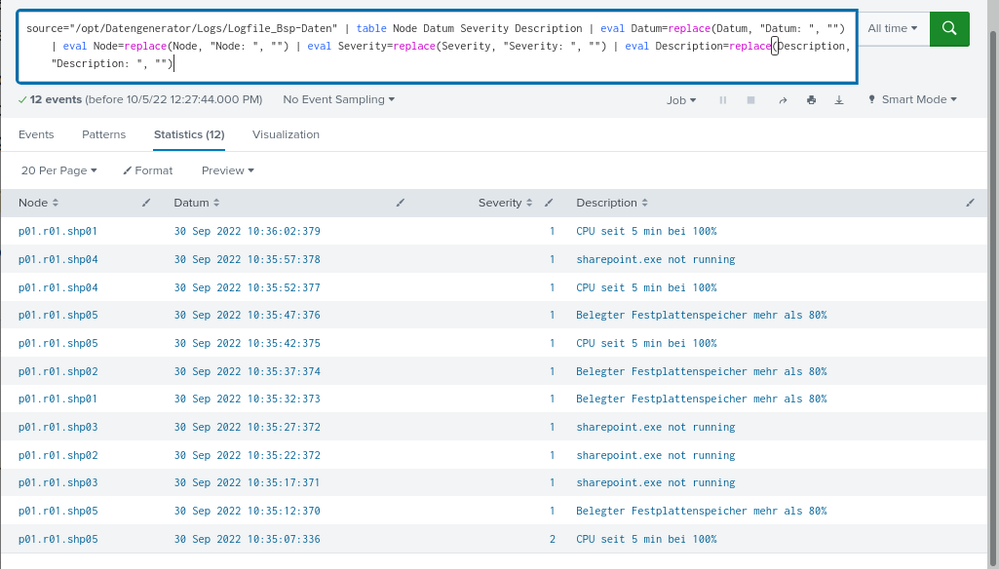
Hey Guys, I have the following Event Data (Picture 1) that come into splunk via universal forwarder. I managed it to generate a table out of it (by using different operations like a delimiter by /n and the statements of picture 2). My Question is:
Can I define permanent interpreting rules for specific directories, so that the statements of picture 2 and the delimiter by /n are permanently apllicated for some specific directories?:)
Sincreley Leon
- Mark as New
- Bookmark Message
- Subscribe to Message
- Mute Message
- Subscribe to RSS Feed
- Permalink
- Report Inappropriate Content


Hi @leon12,
at first the term "data Model" in Splunk means a different thing that you mean: a data Model is a table containing data extracted from events and archived in a MongoDB table, probably you are meaning "dataset".
Anyway, the parsing configurations are stored in props.conf and are fixed for that sourcetype.
props.conf must be located on the Indexers or, if present, on Heavy Forwarders.
Also the eval transformations can be inserted in the props.conf so you don't need to repeat them in eavery search.
The association between an input folder and a sourcetype is done by you in the inputs.conf.
ciao.
Giuseppe


Join the Splunk Community Slack to learn, troubleshoot, and make connections with fellow Splunk practitioners in real time!
Join Splunk User Groups to connect and learn in-person by region or remotely by topic or industry.
Persistent Queue at TcpOut — One of Splunk's Most Practical Features
Skip the Awkward Silence: Have a .conf-ersation at .conf26
Rethinking Zero Trust: From Product Purchases to Logical Control Evidence
