
Join the Conversation
- Find Answers
- :
- Splunk Administration
- :
- Getting Data In
- :
- Why are the timestamps different when indexing CSV...
- Subscribe to RSS Feed
- Mark Topic as New
- Mark Topic as Read
- Float this Topic for Current User
- Bookmark Topic
- Subscribe to Topic
- Mute Topic
- Printer Friendly Page
- Mark as New
- Bookmark Message
- Subscribe to Message
- Mute Message
- Subscribe to RSS Feed
- Permalink
- Report Inappropriate Content

I'm having an issues with timestamps on CSV files. Here is what a sample of raw data looks like:
    DATE,HOUR,WORKFILE_COUNT,RATE_PER_WORKFILE,EST_NBR_WORKFILES_PER_HOUR,WORK_HOLD_FILE_COUNT,WORK_DONE_FILE_COUNT,UNPROCESSED_FILE_COUNT,BAD_FILE_COUNT
09/13/15,15,1172,247.238,14560.9,0,0,0,13
09/13/15,16,1190,247.011,14574.3,0,0,0,13
09/13/15,17,1217,227.313,15837.2,0,0,0,13
09/13/15,18,782,231.839,15528,0,0,0,13
09/13/15,19,648,240.61,14962,0,0,0,13
09/13/15,20,629,238.669,15083.6,0,0,0,13
09/13/15,21,394,242.297,14857.8,0,0,0,13
09/13/15,22,493,295.181,12195.9,0,0,0,13
09/13/15,23,257,280.949,12813.7,0,0,0,13
09/14/15,00,64,235.125,15311,0,0,0,13
Here is the props.conf in /etc/system/local on the indexer:
[csv]
NO_BINARY_CHECK = true
TIMESTAMP_FIELDS = DATE,HOUR
TIME_FORMAT = %m/%d/%y%n%k
disabled = false
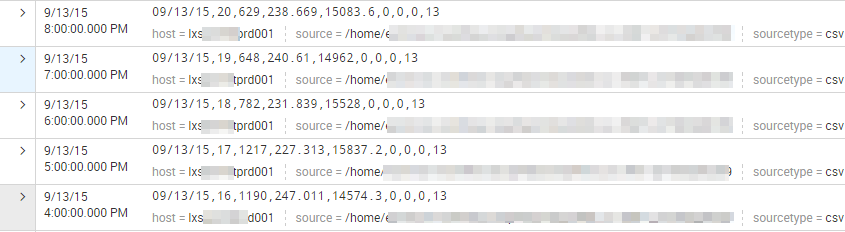
Now when I index locally using the CSV sourcetype, everything looks good and the timestamp is correct:
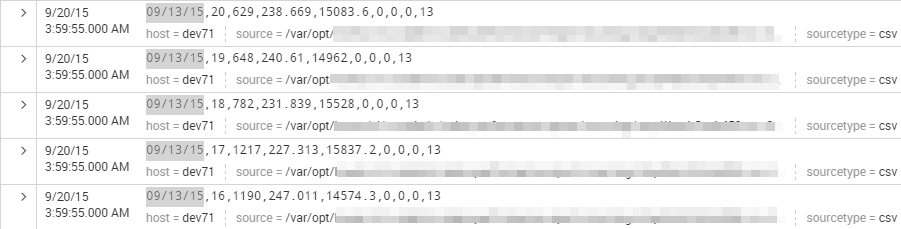
Now, when I have the same file sent via universal forwarder, the modtime is used as the timestamp, not the DATE, HOUR columns in the csv file:
I have tried a variety of things with the props.conf file, but all seems to be failing when it is sent via the forwarder.


- Mark as New
- Bookmark Message
- Subscribe to Message
- Mute Message
- Subscribe to RSS Feed
- Permalink
- Report Inappropriate Content

Hi ragedsparrow,
I guess your INDEXED_EXTRACTIONS = csv is configured in the forwarder's props.conf (Splunk v6) then the forwarder will be parsing the csv file into a structured stream first and then passing it to the indexer ready for immediate indexing (i.e. the indexer will not parse the file again).
Refer to the following in the docs: http://docs.splunk.com/Documentation/Splunk/6.2.2/Data/Extractfieldsfromfileheadersatindextime#Cavea...
You will need to deloy your props configuration to your forwarders, or define another sourcetype for the csv files and ensure the INDEXED_EXTRACTIONS does not happen on the forwarder so the data is forwarded to the indexer in an unstructured state.
Hope this makes sense and helps.
- Mark as New
- Bookmark Message
- Subscribe to Message
- Mute Message
- Subscribe to RSS Feed
- Permalink
- Report Inappropriate Content
Hi ragedsparrow,
I guess your INDEXED_EXTRACTIONS = csv is configured in the forwarder's props.conf (Splunk v6) then the forwarder will be parsing the csv file into a structured stream first and then passing it to the indexer ready for immediate indexing (i.e. the indexer will not parse the file again).
Refer to the following in the docs: http://docs.splunk.com/Documentation/Splunk/6.2.2/Data/Extractfieldsfromfileheadersatindextime#Cavea...
You will need to deloy your props configuration to your forwarders, or define another sourcetype for the csv files and ensure the INDEXED_EXTRACTIONS does not happen on the forwarder so the data is forwarded to the indexer in an unstructured state.
Hope this makes sense and helps.
- Mark as New
- Bookmark Message
- Subscribe to Message
- Mute Message
- Subscribe to RSS Feed
- Permalink
- Report Inappropriate Content
gcato, that is exactly what was happening (a good indicator, I need to read documentation more). I was modifying my props.conf file on the indexer and not on the forwarder, that's why the timestamps were working on my test data that I was bringing in locally on the indexer and not on the forwarded data. Thank you so much for helping with this headache for me.
- Mark as New
- Bookmark Message
- Subscribe to Message
- Mute Message
- Subscribe to RSS Feed
- Permalink
- Report Inappropriate Content
Glad it helped. A case of been there, done that for me.

Join the Splunk Community Slack to learn, troubleshoot, and make connections with fellow Splunk practitioners in real time!
Join Splunk User Groups to connect and learn in-person by region or remotely by topic or industry.
Announcing Modern Navigation: A New Era of Splunk User Experience
Modernize your Splunk Apps – Introducing Python 3.13 in Splunk
Step into “Hunt the Insider: An Splunk ES Premier Mystery” to catch a cybercriminal ...
