
Join the Conversation
- Find Answers
- :
- Apps & Add-ons
- :
- All Apps and Add-ons
- :
- All Apps and Add-ons
- :
- How to call a REST API using POST method to get da...
- Subscribe to RSS Feed
- Mark Topic as New
- Mark Topic as Read
- Float this Topic for Current User
- Bookmark Topic
- Subscribe to Topic
- Mute Topic
- Printer Friendly Page
- Mark as New
- Bookmark Message
- Subscribe to Message
- Mute Message
- Subscribe to RSS Feed
- Permalink
- Report Inappropriate Content
How to call a REST API using POST method to get data using Splunk add-on builder?

Hello,
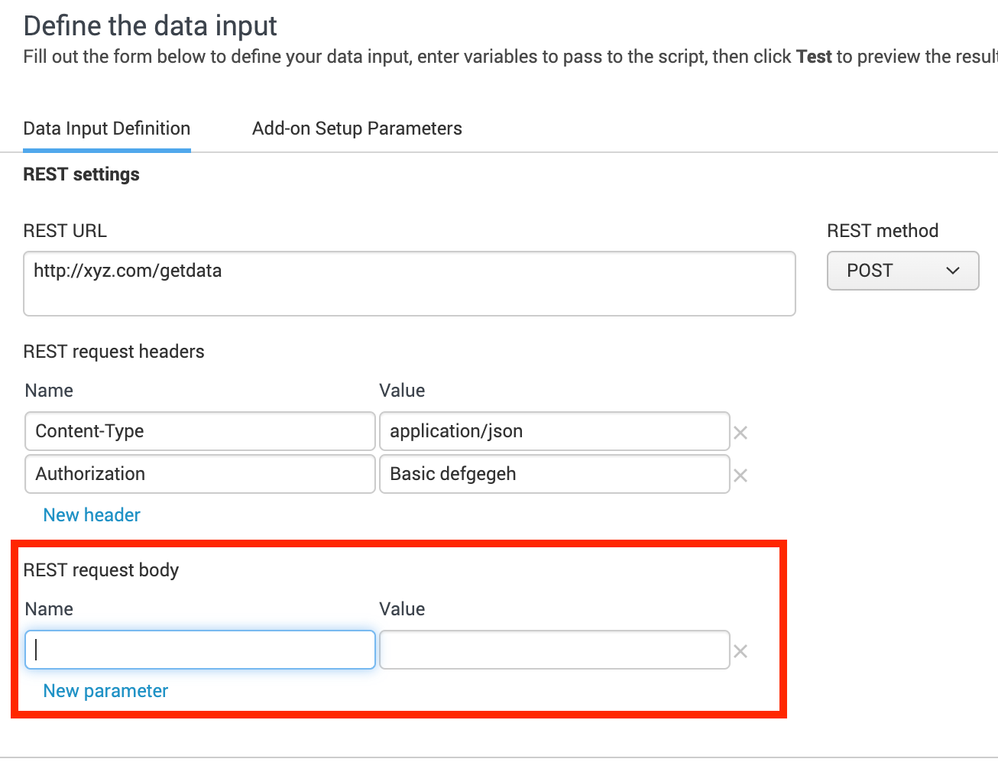
I am trying to get data in using Splunk rest API feature of Splunk add-on builder, however I am not able to get the results using POST method.
Does anyone know what is the correct syntax to pass JSON query in REST request body?
I tried using "data","payload","raw" as Name and in Value I have put the JSON query but it's not working.
I keep getting The response status=500 for request ....
PS: I have used postman to validate my request body and it works fine and return results. however, I am not able to do that using Splunk rest API. Not sure if I am missing something.
- Mark as New
- Bookmark Message
- Subscribe to Message
- Mute Message
- Subscribe to RSS Feed
- Permalink
- Report Inappropriate Content

I know this is an old post, but posting an answer in case others need it.
To translate the body { "key1":"value1", "key2": "value2", ...}
The AOB request body will be :
Name: key1 Value: value1
Name: key2 Value: value2
Name: ..... Value: .......
Also, I see you're using Basic Auth. I'd suggest using Global Account in Add-On Setup Parameters. It should have a checkbox for Basic Auth.

Join the Splunk Community Slack to learn, troubleshoot, and make connections with fellow Splunk practitioners in real time!
Join Splunk User Groups to connect and learn in-person by region or remotely by topic or industry.
Make Your Machine Data AI-Ready in Splunk
Splunk Asynchronous Forwarding Explained
How to Monitor AI Agents with Splunk Agent Observability
