
Turn on suggestions
Auto-suggest helps you quickly narrow down your search results by suggesting possible matches as you type.
Splunk Search
×
Join the Conversation
Without signing in, you're just watching from the sidelines. Sign in or Register to connect, share, and be part of the Splunk Community.
- Find Answers
- :
- Using Splunk
- :
- Splunk Search
- :
- Showing errors when try to send data to splunk clo...
Options
- Subscribe to RSS Feed
- Mark Topic as New
- Mark Topic as Read
- Float this Topic for Current User
- Bookmark Topic
- Subscribe to Topic
- Mute Topic
- Printer Friendly Page
- Mark as New
- Bookmark Message
- Subscribe to Message
- Mute Message
- Subscribe to RSS Feed
- Permalink
- Report Inappropriate Content
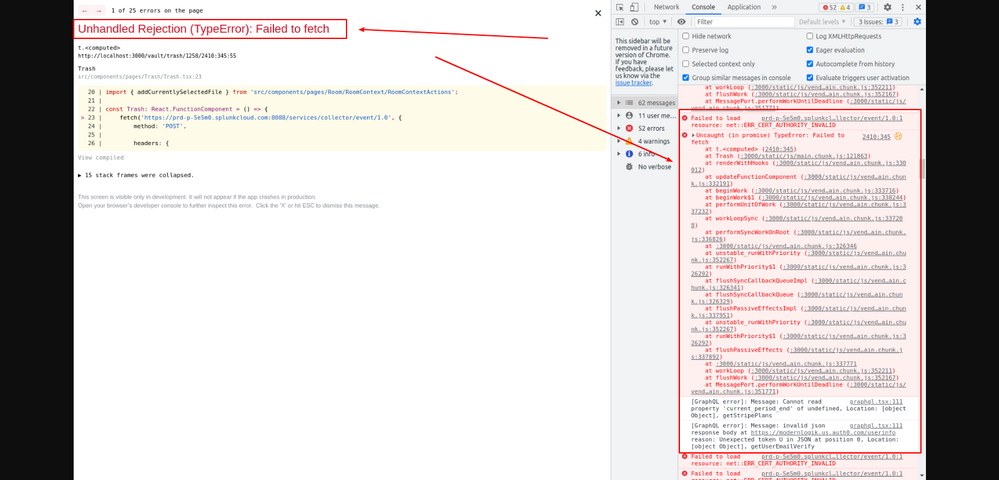
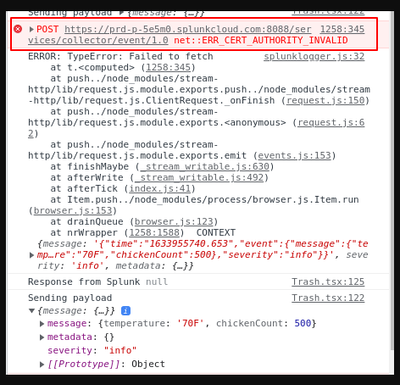
Showing errors when try to send data to splunk cloud in reactjs but it's working fine with postman and curl in terminal?

Herry
New Member
10-11-2021
05:41 AM
Using fecth in reactjs:
fetch('https://[SUBDOMAIN].splunkcloud.com:8088/services/collector/event/1.0', {
method: 'POST',
headers: {
'Access-Control-Allow-Origin': 'application/json',
'Access-Control-Allow-Credentials': 'true',
'Access-Control-Allow-Methods': 'OPTIONS, GET, POST',
'Access-Control-Allow-Headers':
'Content-Type, Depth, User-Agent, X-File-Size, X-Requested-With, If-Modified-Since, X-File-Name, Cache-Control',
Accept: 'application/json',
'Content-Type': 'application/json',
Authorization: 'Splunk [TOKEN]'
},
body: JSON.stringify({
sourcetype: '_json',
index: 'main',
host: 'mydata2',
event: { foo: 'bar3', b: ['value1_3', 'value1_4'] }
})
})
.then((res) => res.json())
.then((json) => {
// eslint-disable-next-line no-console
console.log('json---->', json);
});
Using splunk-logging in reactjs:
import * as SplunkLogging from 'splunk-logging';
const SplunkLogger = SplunkLogging.Logger;
const config = {
token: [TOKEN],
url: '[URL]:8088'
};
// eslint-disable-next-line no-var
const Logger = new SplunkLogger(config);
Logger.requestOptions.strictSSL = true;
// eslint-disable-next-line no-var
const payload = {
// Message can be anything; doesn't have to be an object
message: {
temperature: '70F',
chickenCount: 500
}
};
console.info('Sending payload', payload);
Logger.send(payload, function (err, resp, body) {
// If successful, body will be { text: 'Success', code: 0 }
console.info('Response from Splunk', body);
});
- Mark as New
- Bookmark Message
- Subscribe to Message
- Mute Message
- Subscribe to RSS Feed
- Permalink
- Report Inappropriate Content
sxmudem
New Member
10-16-2022
03:19 PM
Is there any luck for above error.I am also seeing same error

Got questions? Get answers!
Join the Splunk Community Slack to learn, troubleshoot, and make connections with fellow Splunk practitioners in real time!
Meet up IRL or virtually!
Join Splunk User Groups to connect and learn in-person by region or remotely by topic or industry.
Get Updates on the Splunk Community!
Persistent Queue at TcpOut — One of Splunk's Most Practical Features
Splunk introduced persistent queueing at the tcpout layer as one of the most practical resilience features in ...
Build resilience for the agentic era: Join us at Splunk Go San Jose
AI is changing how organizations build, operate, and secure digital services. As teams adopt AI agents and ...
Manage Edge Processor pipelines end to end with APIs
This guide uses the Data Management APIs to create an Edge Processor, onboard one instance, deploy a pipeline ...
