
Join the Conversation
- Find Answers
- :
- Using Splunk
- :
- Splunk Search
- :
- Query Performace
- Subscribe to RSS Feed
- Mark Topic as New
- Mark Topic as Read
- Float this Topic for Current User
- Bookmark Topic
- Subscribe to Topic
- Mute Topic
- Printer Friendly Page
- Mark as New
- Bookmark Message
- Subscribe to Message
- Mute Message
- Subscribe to RSS Feed
- Permalink
- Report Inappropriate Content

Hello,
I am building a query to be able to display a line graph of status (offline, online) over a period of 30days. Query currently is so slow it usually doesn't finish. looking for assistance to see if I can do something different to speed it up. thanks!
Current query:
index=mydata sourcetype="mySourceType" (_raw=*offline* OR _raw=*online*)
| eval status=if(like(_raw, "%offline%"),"Offline","Online")
| timechart span=1d count by status
- Mark as New
- Bookmark Message
- Subscribe to Message
- Mute Message
- Subscribe to RSS Feed
- Permalink
- Report Inappropriate Content

hi @dglass0215,
You don't need to use wildcard (*) in the base search. Try the below query without the timechart first and check the performance. Then add timechart and check the performance.
index=mydata sourcetype="mySourceType" offline OR online
| rex "(?<status>offline)"
| eval status=if(status="offline","Offline","Online")
- Mark as New
- Bookmark Message
- Subscribe to Message
- Mute Message
- Subscribe to RSS Feed
- Permalink
- Report Inappropriate Content


Create a field extraction where you extract the current status from raw for that sourcetype, so when you search for it, you can search for all records with status, e.g.
index=mydata sourcetype="mySourceType" status=*
| timechart span=1d count by status
otherwise the leading wildcard combined with _raw= is going to have to search all the data for that sourcetype for your time period. Any row that does not have an extracted status field will not be found.
- Mark as New
- Bookmark Message
- Subscribe to Message
- Mute Message
- Subscribe to RSS Feed
- Permalink
- Report Inappropriate Content
Not sure how to do that when the data is unstructured.
- Mark as New
- Bookmark Message
- Subscribe to Message
- Mute Message
- Subscribe to RSS Feed
- Permalink
- Report Inappropriate Content
Take a look at the field extractor in the UI - you can get there from a raw event, via the Event Actions drop down. Splunk is great at unstructured data and it's really good to take a look at how you do field extractions, as it will help you a lot.
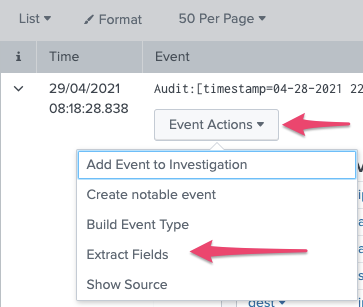
You can extract fields based on regular expressions or delimiters, if you don't know much about regex, then https://regex101.com is a good place to look to play with regex.
- Mark as New
- Bookmark Message
- Subscribe to Message
- Mute Message
- Subscribe to RSS Feed
- Permalink
- Report Inappropriate Content
hi @dglass0215,
You don't need to use wildcard (*) in the base search. Try the below query without the timechart first and check the performance. Then add timechart and check the performance.
index=mydata sourcetype="mySourceType" offline OR online
| rex "(?<status>offline)"
| eval status=if(status="offline","Offline","Online")
- Mark as New
- Bookmark Message
- Subscribe to Message
- Mute Message
- Subscribe to RSS Feed
- Permalink
- Report Inappropriate Content
Thank you. This definitely helped to speed it up.


Join the Splunk Community Slack to learn, troubleshoot, and make connections with fellow Splunk practitioners in real time!
Join Splunk User Groups to connect and learn in-person by region or remotely by topic or industry.
Self-Healing Pipeline Is Now Generally Available: AI-Powered CIM Compliance
Meet Splunk Observability Studio: AI-Assisted OpenTelemetry Instrumentation Without ...
Federated Search for Cisco Security and Analytics Logging (SAL) is now GA on Splunk ...
