
Turn on suggestions
Auto-suggest helps you quickly narrow down your search results by suggesting possible matches as you type.
Splunk Search
×
Join the Conversation
Without signing in, you're just watching from the sidelines. Sign in or Register to connect, share, and be part of the Splunk Community.
- Find Answers
- :
- Using Splunk
- :
- Splunk Search
- :
- Display Dates that Expire in 90 days
Options
- Subscribe to RSS Feed
- Mark Topic as New
- Mark Topic as Read
- Float this Topic for Current User
- Bookmark Topic
- Subscribe to Topic
- Mute Topic
- Printer Friendly Page
- Mark as New
- Bookmark Message
- Subscribe to Message
- Mute Message
- Subscribe to RSS Feed
- Permalink
- Report Inappropriate Content

jordanking1992
Path Finder
09-24-2019
12:48 PM
Hello,
We have a field called "Certificate Expiration Date" and trying to only show items that expire 90 days or less. Have tried fieldformat with no luck.
Suggestions?
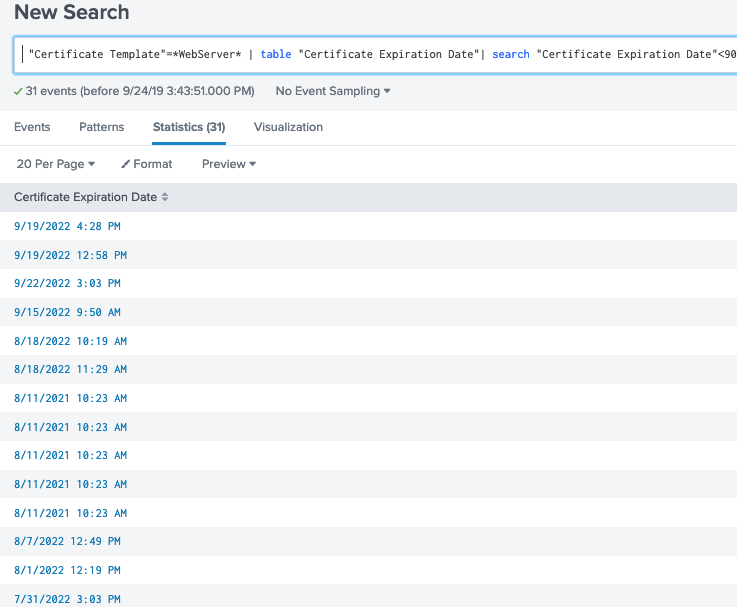

1 Solution
- Mark as New
- Bookmark Message
- Subscribe to Message
- Mute Message
- Subscribe to RSS Feed
- Permalink
- Report Inappropriate Content

jacobpevans
Motivator
09-24-2019
01:45 PM
Greetings @jordanking1992,
Here's a run-anywhere example:
           | makeresults | eval CertificateExpirationDate =  "9/24/2018 10:00 PM"
| append [ | makeresults | eval CertificateExpirationDate =  "9/24/2019 10:00 PM" ]
| append [ | makeresults | eval CertificateExpirationDate = "12/20/2019 10:00 PM" ]
| append [ | makeresults | eval CertificateExpirationDate =  "1/10/2020 10:00 PM" ]
| append [ | makeresults | eval CertificateExpirationDate =  "9/24/2020 10:00 PM" ]
| eval  CertificateExpirationDate_epoch = strptime(CertificateExpirationDate, "%m/%d/%Y %I:%M %p")
| where CertificateExpirationDate_epoch < (now() + 90*86400) AND CertificateExpirationDate_epoch > now()
| fields - CertificateExpirationDate_epoch
For your data, it will look more like this:
[your base search]
| eval  CertificateExpirationDate_epoch = strptime('Certificate Expiration Date', "%m/%d/%Y %I:%M %p")
| where CertificateExpirationDate_epoch < (now() + 90*86400)
| fields - CertificateExpirationDate_epoch
If you only want values in the future, add another check for after now()
| where CertificateExpirationDate_epoch < (now() + 90*86400) AND CertificateExpirationDate_epoch > now()
Cheers,
Jacob
If you feel this response answered your question, please do not forget to mark it as such. If it did not, but you do have the answer, feel free to answer your own post and accept that as the answer.
Jacob
If you feel this response answered your question, please do not forget to mark it as such. If it did not, but you do have the answer, feel free to answer your own post and accept that as the answer.
- Mark as New
- Bookmark Message
- Subscribe to Message
- Mute Message
- Subscribe to RSS Feed
- Permalink
- Report Inappropriate Content
jacobpevans
Motivator
09-24-2019
01:45 PM
Greetings @jordanking1992,
Here's a run-anywhere example:
           | makeresults | eval CertificateExpirationDate =  "9/24/2018 10:00 PM"
| append [ | makeresults | eval CertificateExpirationDate =  "9/24/2019 10:00 PM" ]
| append [ | makeresults | eval CertificateExpirationDate = "12/20/2019 10:00 PM" ]
| append [ | makeresults | eval CertificateExpirationDate =  "1/10/2020 10:00 PM" ]
| append [ | makeresults | eval CertificateExpirationDate =  "9/24/2020 10:00 PM" ]
| eval  CertificateExpirationDate_epoch = strptime(CertificateExpirationDate, "%m/%d/%Y %I:%M %p")
| where CertificateExpirationDate_epoch < (now() + 90*86400) AND CertificateExpirationDate_epoch > now()
| fields - CertificateExpirationDate_epoch
For your data, it will look more like this:
[your base search]
| eval  CertificateExpirationDate_epoch = strptime('Certificate Expiration Date', "%m/%d/%Y %I:%M %p")
| where CertificateExpirationDate_epoch < (now() + 90*86400)
| fields - CertificateExpirationDate_epoch
If you only want values in the future, add another check for after now()
| where CertificateExpirationDate_epoch < (now() + 90*86400) AND CertificateExpirationDate_epoch > now()
Cheers,
Jacob
If you feel this response answered your question, please do not forget to mark it as such. If it did not, but you do have the answer, feel free to answer your own post and accept that as the answer.
Jacob
If you feel this response answered your question, please do not forget to mark it as such. If it did not, but you do have the answer, feel free to answer your own post and accept that as the answer.

Got questions? Get answers!
Join the Splunk Community Slack to learn, troubleshoot, and make connections with fellow Splunk practitioners in real time!
Meet up IRL or virtually!
Join Splunk User Groups to connect and learn in-person by region or remotely by topic or industry.
Get Updates on the Splunk Community!
Announcing Modern Navigation: A New Era of Splunk User Experience
We are excited to introduce the Modern Navigation feature in the Splunk Platform, available to both cloud and ...
Observability Simplified: Combining User Experience, Application Performance & ...
Tech Talk
Observability Simplified: Combining User Experience, Application Performance & Network ...
Event Series May & June: From Network Visibility to Service Intelligence
Unifying the Network: Moving from Alert Noise to Service Intelligence with Splunk ITSI
In today’s hybrid ...
