
Join the Conversation
- Find Answers
- :
- Using Splunk
- :
- Splunk Search
- :
- Re: Foreach weird bug in variable
- Subscribe to RSS Feed
- Mark Topic as New
- Mark Topic as Read
- Float this Topic for Current User
- Bookmark Topic
- Subscribe to Topic
- Mute Topic
- Printer Friendly Page
- Mark as New
- Bookmark Message
- Subscribe to Message
- Mute Message
- Subscribe to RSS Feed
- Permalink
- Report Inappropriate Content

So I have this chunk of code
eval matched=0 | foreach UF* [eval matched = if(like('<<FIELD>>',valMask),matched+1,matched) | eval Property = if(matched>=1,Property,null)]
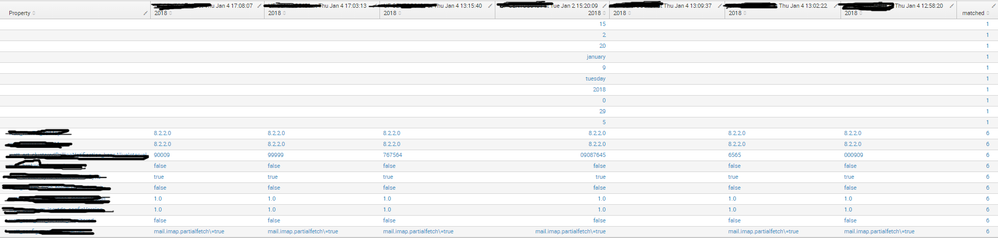
Amusingly if the matched variable equals 1, the Property will get null value, when I explicity say that if it is bigger or equal than 1, the Property should remain with her original value.
Proof matched = 1
Thoughts on this ?
Thanks

- Mark as New
- Bookmark Message
- Subscribe to Message
- Mute Message
- Subscribe to RSS Feed
- Permalink
- Report Inappropriate Content
So apparently, matched inside the foreach is still 0. Something like Lazy Evaluation, but I don't really know. Anyway.. this works
foreach UF* [eval matched = if(like('<<FIELD>>',valMask),matched+1,matched)] | eval Property = if(matched>=1,Property,null)
- Mark as New
- Bookmark Message
- Subscribe to Message
- Mute Message
- Subscribe to RSS Feed
- Permalink
- Report Inappropriate Content
So apparently, matched inside the foreach is still 0. Something like Lazy Evaluation, but I don't really know. Anyway.. this works
foreach UF* [eval matched = if(like('<<FIELD>>',valMask),matched+1,matched)] | eval Property = if(matched>=1,Property,null)
- Mark as New
- Bookmark Message
- Subscribe to Message
- Mute Message
- Subscribe to RSS Feed
- Permalink
- Report Inappropriate Content

The structure generally looks ok, so I'm kind of reaching here. Any chance Property was null before the second half of the foreach ran? If you remove the second eval clause, is Property always populated?
- Mark as New
- Bookmark Message
- Subscribe to Message
- Mute Message
- Subscribe to RSS Feed
- Permalink
- Report Inappropriate Content
The only possibility I'm seeing is that matched is still 0 inside the foreach. Like a lazy interation
- Mark as New
- Bookmark Message
- Subscribe to Message
- Mute Message
- Subscribe to RSS Feed
- Permalink
- Report Inappropriate Content
I removed the eval clause, and all the Properties get populated..
- Mark as New
- Bookmark Message
- Subscribe to Message
- Mute Message
- Subscribe to RSS Feed
- Permalink
- Report Inappropriate Content

Can you try
eval matched=0 | foreach UF* [eval matched = if(like('<<FIELD>>',valMask),matched+1,matched) ]| foreach UF* [eval Property=if(matched>=1,Property,null)]
- Mark as New
- Bookmark Message
- Subscribe to Message
- Mute Message
- Subscribe to RSS Feed
- Permalink
- Report Inappropriate Content
Same result.. What was your reasoning ?

Join the Splunk Community Slack to learn, troubleshoot, and make connections with fellow Splunk practitioners in real time!
Join Splunk User Groups to connect and learn in-person by region or remotely by topic or industry.
Make Your Machine Data AI-Ready in Splunk
Splunk Asynchronous Forwarding Explained
How to Monitor AI Agents with Splunk Agent Observability
