
Join the Conversation
- Find Answers
- :
- Using Splunk
- :
- Splunk Search
- :
- Extracting Key Value Pairs from a JSON object and ...
- Subscribe to RSS Feed
- Mark Topic as New
- Mark Topic as Read
- Float this Topic for Current User
- Bookmark Topic
- Subscribe to Topic
- Mute Topic
- Printer Friendly Page
- Mark as New
- Bookmark Message
- Subscribe to Message
- Mute Message
- Subscribe to RSS Feed
- Permalink
- Report Inappropriate Content
Extracting Key Value Pairs from a JSON object and convert them to fields

Hello Splunk Community,
We have two types of logs being forwarded to splunk a simple .log file and json logs that are being forwarded to splunk.
I am only interested in one of the objects which has key-value pairs. In this example I am only interested in the log object.
JSON LOG
{ [-]
   kubernetes: { [+]
   }
   log: 2020-06-24T13:23:12.8735410Z CI=4fomit248-2e46-4omit9-8019-838cdac1a4a4 L=INFO This is some log message here HRM=GET HRU=http://00.00.000.00:80/bar/v1/foo IP=::ffff:00.00.000.000 AV=? HSC=200 ET=1

   stream: stdout
   time: 2020-06-24T13:23:12.873853339Z
}
In the log object I want the fields to be extracted as followed:
| Key | Value |
| CI | 4fomit248-2e46-4omit9-8019-838cdac1a4a4 |
| L | INFO |
| IP | ::ffff:00.00.000.000 |
| <THIS WOULD BE THE LOG MESSAGE NOT A KEY> | This is some log message here |
I understand how to parse fields from the spath output using regex. However I would prefer this is is parsed at index time.
Our other set of logs are exactly what is in the log object they are not in JSON format and splunk picks up the fields just fine.
Log from .log file
2020-06-24 06:41:31.195 ST=C5D17Domitted72738B0D136DA9 CI=b1d0b050-omitted-46d2-omitted-80a61dfadf7d L=INFO Some log message here HRM=GET SN=FOO MN=Get HRU=http://foo.omit/bar/v2/foobar IP=00.00.000.000 ET=31 HSC=200 FOWCF=4
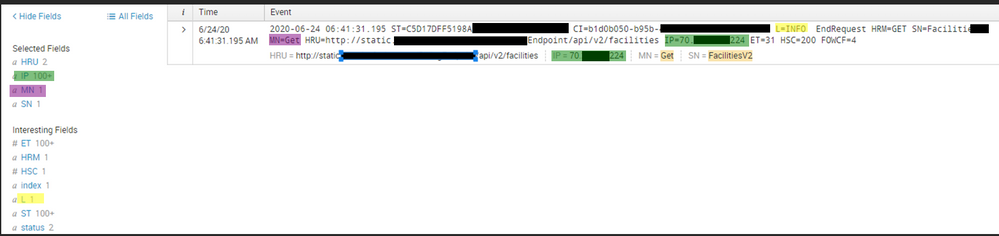
Is it possible to extract the log object at index time and turn it into its own log where the key value pairs are extracted as fields?
I also read this blog post is this the best approach?
Eureka! Extracting key-value pairs from JSON fields


Join the Splunk Community Slack to learn, troubleshoot, and make connections with fellow Splunk practitioners in real time!
Join Splunk User Groups to connect and learn in-person by region or remotely by topic or industry.
Agentic SOC Triage: Investigating Splunk ES Notables with MCP Server and a Local LLM
All Work and No Play? Not at .conf26! Unwind at These Evening Events
Join the Hackathon at .conf26 and build a No-Code AI agent
